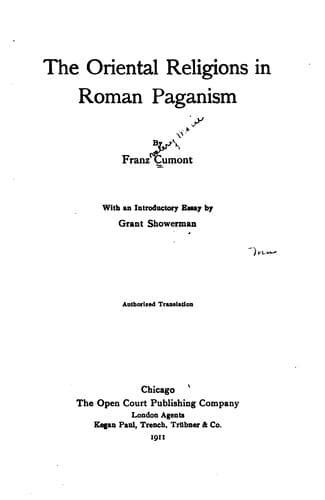
The Oriental Religions in Roman PaganismCumont, Franz
Religion
The Oriental Religions in Roman Paganism
Cumont, Franz
Paganism -- Rome; Religions; Rome -- Religion
However, there are ways of reaching an agreement with the police, and in
this case custom was stronger than law. The intermittent rigor of imperial
edicts had no more power to destroy an inveterate superstition than the
Christian polemics had to cure it. It was a recognition of its strength
when state and church united to fight it. Neither reached the root of the
evil, for they did not deny the reality of the power wielded by the
sorcerers. As long as it was admitted that malicious spirits constantly
interfered in human affairs, and that there were secret means enabling the
operator to dominate those spirits or to share in their power, magic was
indestructible. It appealed to too many human passions to remain unheard.
If, on the one hand, the desire of penetrating the mysteries of the future,
the fear of unknown misfortunes, and hope, always reviving, led the anxious
masses to seek a chimerical certainty in astrology, on the other hand, in
the case of magic, the blinding charm of the marvelous, the entreaties of
love and ambition, the bitter desire for revenge, the fascination of crime,
and the intoxication of bloodshed,--all the instincts that are not avowable
and that are satisfied in the dark, took turns in practising their
seductions. During the entire life of the Roman empire its existence
continued, and the very mystery that it was compelled to hide in increased
its prestige and almost gave it the authority of a revelation.
A curious occurrence that took place towards the end of the fifth century
at Beirut, in Syria, shows how deeply even the strongest intellects of that
period believed in the most atrocious practices of magic. One night some
students of the famous law-school of that {193} city attempted to kill a
slave in the circus, to aid the master in obtaining the favor of a woman
who scorned him. Being reported, they had to deliver up their hidden
volumes, of which those of Zoroaster and of Hostanes were found, together
with those written by the astrologer Manetho. The whole city was agitated,
and searches proved that many young men preferred the study of the illicit
science to that of Roman law. By order of the bishop a solemn auto-da-fe
was made of all this literature, in the presence of the city officials and
the clergy, and the most revolting passages were read in public, "in order
to acquaint everybody with the conceited and vain promises of the demons,"
as the pious writer of the story says.[81]
Public-domain text, read in full here on John Shaqi.
Reviews
Reviews
No reviews yet
Be the first to share your thoughts on this work.
Elsewhere in the archive
Join the Discussion
Join the discussion
Sign in to leave a comment or review.
Sign InorCreate an account