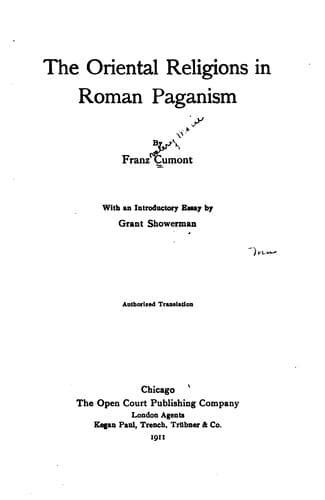
The Oriental Religions in Roman PaganismCumont, Franz
Religion
The Oriental Religions in Roman Paganism
Cumont, Franz
Paganism -- Rome; Religions; Rome -- Religion
The universe was an organism animated by a God, unique, eternal and
almighty. Sometimes this God was identified with the destiny that ruled all
things, with infinite time that regulated all visible phenomena, and he was
worshiped in each subdivision of that endless duration, especially in the
months and the seasons.[18] Sometimes, however, he was compared with a
king; he was thought of as a sovereign governing an empire, and the various
gods then were the princes and dignitaries interceding with the rulers on
behalf of his subjects whom they led in some manner into his presence. This
heavenly court had its messengers or "angels" conveying to men the will of
the master and reporting again the vows and petitions of his subjects. It
was an aristocratic monarchy in heaven as on earth.[19] A more philosophic
conception made the divinity an infinite power impregnating all nature with
its overflowing forces. "There is only one God, sole and supreme," wrote
Maximus of Madaura about 390, "without beginning or parentage, whose
energies, diffused through the world, we invoke under various names,
because we are ignorant of his real name. By successively addressing our
supplications to his different members we intend to honor him in his
entirety. Through the mediation of the subordinate gods the common father
both of themselves and of all men is honored in a thousand different ways
by mortals who are thus in accord in spite of their discord."[20]
However, this ineffable God, who comprehensively embraces everything,
manifests himself especially in {208} the resplendent brightness of the
ethereal sky.[21] He reveals his power in water and in fire, in the earth,
the sea and the blowing of the winds; but his purest, most radiant and most
active epiphany is in the stars whose revolutions determine every event and
all our actions. Above all he manifests himself in the sun, the motive
power of the celestial spheres, the inexhaustible seat of light and life,
the creator of all intelligence on earth. Certain philosophers like the
senator Praetextatus, one of the _dramatis personae_ of Macrobius,
confounded all the ancient divinities of paganism with the sun in a
thorough-going syncretism.[22]
Public-domain text, read in full here on John Shaqi.
Reviews
Reviews
No reviews yet
Be the first to share your thoughts on this work.
Elsewhere in the archive
Join the Discussion
Join the discussion
Sign in to leave a comment or review.
Sign InorCreate an account