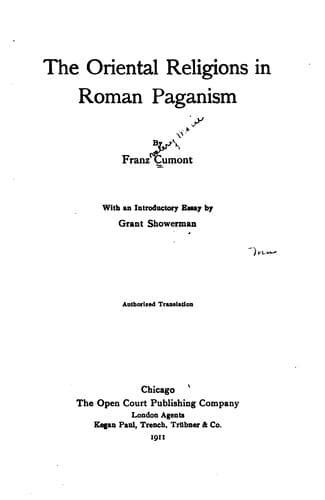
The Oriental Religions in Roman PaganismCumont, Franz
Religion
The Oriental Religions in Roman Paganism
Cumont, Franz
Paganism -- Rome; Religions; Rome -- Religion
But at the other extremity of the world, facing this luminous realm,
extended the somber kingdom of evil spirits. They were irreconcilable
adversaries of the gods and men of good will, and constantly left the
infernal regions to roam about the earth and scatter evil. With the aid of
the celestial spirits, the faithful had to struggle forever against their
designs and seek to avert their anger by means of bloody sacrifices. {210}
But, with the help of occult and terrible processes, the magician could
subject them to his power and compel them to serve his purposes. This
demonology, the monstrous offspring of Persian dualism, favored the rise of
every superstition.[26]
However, the reign of the evil powers was not to last forever. According to
common opinion the universe would be destroyed by fire[27] after the times
had been fulfilled. All the wicked would perish, but the just would be
revived and establish the reign of universal happiness in the regenerated
world.[28]
The foregoing is a rapid sketch of the theology of paganism after three
centuries of Oriental influence. From coarse fetichism and savage
superstitions the learned priests of the Asiatic cults had gradually
produced a complete system of metaphysics and eschatology, as the Brahmins
built up the spiritualistic monism of the Vedanta beside the monstrous
idolatry of Hinduism, or, to confine our comparisons to the Latin world, as
the jurists drew from the traditional customs of primitive tribes the
abstract principles of a legal system that governs the most cultivated
societies. This religion was no longer like that of ancient Rome, a mere
collection of propitiatory and expiatory rites performed by the citizen for
the good of the state; it now pretended to offer to all men a
world-conception which gave rise to a rule of conduct and placed the end of
existence in the future life. It was more unlike the worship that Augustus
had attempted to restore than the Christianity that fought it. The two
opposed creeds moved in the same intellectual and moral sphere,[29] and one
could actually pass from one to the other without shock or interruption.
Sometimes when {211} reading the long works of the last Latin writers, like
Ammianus Marcellinus or Boethius, or the panegyrics of the official
orators,[30] scholars could well ask whether their authors were pagan or
Christian. In the time of Symmachus and Praetextatus, the members of the
Roman aristocracy who had remained faithful to the gods of their ancestors
did not have a mentality or morality very different from that of adherents
of the new faith who sat with them in the senate. The religious and
mystical spirit of the Orient had slowly overcome the whole social organism
and had prepared all nations to unite in the bosom of a universal church.
* * * * *
{213}
NOTES.
PREFACE.
Public-domain text, read in full here on John Shaqi.
Reviews
Reviews
No reviews yet
Be the first to share your thoughts on this work.
Elsewhere in the archive
Join the Discussion
Join the discussion
Sign in to leave a comment or review.
Sign InorCreate an account