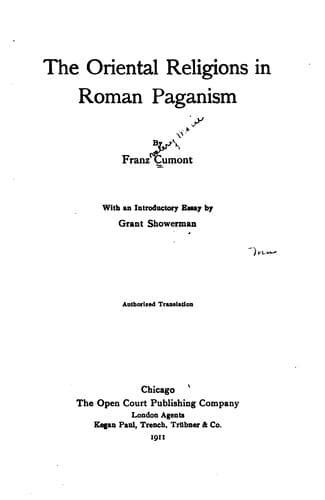
The Oriental Religions in Roman PaganismCumont, Franz
Religion
The Oriental Religions in Roman Paganism
Cumont, Franz
Paganism -- Rome; Religions; Rome -- Religion
6. The theory of the degeneration of races has been set forth in particular
by Stewart Chamberlain, _Die Grundlagen des XIX. Jahrhunderts_, 3d. ed.,
Munich, 1901, pp. 296 ff.--The idea of selection by retrogression, of the
_Ausrottung der Besten_, has been defended, as is well known, by Seeck in
his _Geschichte des Untergangs der antiken Welt_, which outlines the
religious consequence (II, p. 344). His system is developed in the third
volume which appeared in 1909.
7. Apuleius, _Metam._, XI, 14 ff. See Preface. Manilius said of the divine
stars (IV, 910; cf. II, 125),
"_Ipse vocat nostros animos ad sidera mundus_."
8. Hepding, _Attis_, pp. 178 ff., 187.
9. The intimate connection between the juridical and religious ideas of the
Romans has left numerous traces even in their language. One of the most
curious is the double meaning of the term _supplicium_, which stands at the
same time for a supplication addressed to the gods and a punishment {220}
demanded by custom, and later by law. In regard to the development of this
twofold meaning, see the recent note by Richard Heinze, _Archiv fuer
lateinische Lexicographie_, XV, pp. 90 ff. Sematology is often synonymous
with the study of customs.
10 Reville, _op. cit._, p. 144.
11 On ecstasy in the mysteries in general, cf. Rohde, _Psyche_, 2d ed., pp.
315-319; in the Oriental religions cf. De Jong, _De Apuleio Isiacorum
mysteriorum teste_, 1900, p. 100; De Jong, _Das antike Mysterienwesen_,
Leyden, 1909. _Mon. myst. Mithra_, I, p. 323.
12 Firmicus Maternus mentioned this in _De errore prof. relig._, c. 8.
13 For Babylonia, cf. Strab., XVI, 1, Sec. 6, and _infra_, ch. V, n. 51; for
Egypt, _id._, XVII, 21, Sec. 46. From the very interesting account Otto has
written of the science of the Egyptian priests during the Hellenistic
period (_Priester und Tempel_, II, pp. 211 ff.; 234), it appears that it
remained quite worthy of consideration although progress had ceased.
14 Strabo, _loc. cit._: [Greek: Anatitheasi de toi Hermei pasan ten
toiauten sophian]; Pliny, _Hist. nat._, VI, 26, Sec. 121: "(Belus) _inventor
fuit sideralis scientiae_"; cf. Solinus, 56, Sec. 3; Achilles, _Isag._, 1
(Maass, _Comm. in Arat._, p. 27): [Greek: Beloi ten heuresin anathentes].
Let us remember that Hammurabi's code was represented as the work of
Marduk.--In a general way, the gods are the authors of all inventions
useful to humanity; cf. Reitzenstein, _Poimandres_, 1904, p. 123;
Deissmann, _Licht von Osten_, 91 ff. Likewise in the Occident: _CIL_, VII,
759 = Buecheler, _Carm. epigr._, 24: "(Dea Syria) ex quis muneribus nosse
contigit deos," etc., cf. Plut., _Crass._, 17.--"Religion im Sinne des
Orients ist die Erklaerung alles dessen was ist, also eine Weltauffassung"
(Winckler, _Himmelsbild der Babylonier_, 1903, p. 9).
Public-domain text, read in full here on John Shaqi.
Reviews
Reviews
No reviews yet
Be the first to share your thoughts on this work.
Elsewhere in the archive
Join the Discussion
Join the discussion
Sign in to leave a comment or review.
Sign InorCreate an account