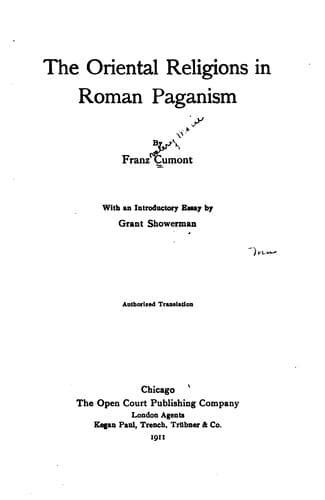
The Oriental Religions in Roman PaganismCumont, Franz
Religion
The Oriental Religions in Roman Paganism
Cumont, Franz
Paganism -- Rome; Religions; Rome -- Religion
15 _Mon. myst. Mithra_, I, p. 312.--Manicheism likewise brought a complete
cosmological system from Babylonia. Saint Augustine criticizes the book of
that sect for containing long dissertations and absurd stories about
matters that have nothing at all to do with salvation; see my _Recherches
sur le manicheisme_, 1908, p. 53.
16 Cf. Porphyry, _Epist. Aneb._, 11; Jambl., _De myst._, II, 11. {221}
17 This upright character of the Roman religion has been thoroughly
expounded by G. Boissier (_op. cit._, I, 30 ff, 373 ff). See also the
remarks by Bailey, _Religion of Ancient Rome_, London, 1907, pp. 103 ff.
18 Varro in Augustine _De civ. Dei_, IV, 27; VI, 5; cf. Varro, _Antiq.
rerum divin._, ed. Aghad, pp. 145 ff. The same distinction between the
religion of the poets, of the legislators and of the philosophers has been
made by Plutarch, _Amatorius_, 18, p. 763 C. The author of this division is
Posidonius of Apamea. See Diels, _Doxographi Graeci_, p. 295, 10, and
Wendland, _Archiv fuer Gesch. der Philos._, I, pp. 200 ff.
19 Luterbacher, _Der Prodigienglaube der Roemer_, Burgdorf, 1904.
20 Juvenal, II, 149; cf. Diodorus, I, 93, Sec. 3. Cf. Plutarch also in
speaking of future punishment (_Non posse suaviter vivi_, c. 26, p. 1104
C-E: _Quo modo poetas aud._, c. 2, p. 17 C-E; _Consol. ad Apollon._, c. 10,
p. 106 F), "nous laisse entendre que pour la plupart de ses contemporains
ce sont la des contes de nourrice qui ne peuvent effrayer que des enfants"
(Decharme, _Traditions religieuses chez les Grecs_, 1904, p. 442).
21 Aug., _Civ. Dei_, VI, 2; Varro, _Antiqu._, ed. Aghad, 141; "Se timere ne
(dii) pereant non incursu hostili sed civium neglegentia."
22 I have developed this point in my _Mon. myst. Mithra_, I, pp. 279 ff.
23 In Greece the Oriental cults expanded much less than in any other
religion, because the Hellenic mysteries, especially those of Eleusis,
taught similar doctrines and satisfied the religious needs.
24 The development of the "ritual of purification" has been broadly
expounded in its entirety, by Farnell in _The Evolution of Religion_, 1905,
pp. 88 ff.
25 We shall mention this subject again when speaking of the taurobolium in
ch. III, pp. 67 ff.
26 We cannot dwell here upon the various forms assumed by that purifying
rite of the Oriental mysteries. Often these forms remained quite primitive,
and the idea that inspired them is still clear, as where Juvenal (VI, 521
f.) pictures the {222} worshiper of the _Magna Mater_ divesting himself of
his beautiful garments and giving them to the _archigallus_ to wipe out all
the misdeeds of the year (_ut totum semel expiet annum_). The idea of a
mechanical transfer of the pollution by relinquishing the clothes is
frequent among savages; see Farnell, _op. cit._, p. 117; also Frazer,
_Golden Bough_, I^2, p. 60.
27 Dieterich, _Eine Mithrasliturgie_, pp. 157 ff.; Hepding, _Attis_, pp.
194 ff.--Cf. Frazer, _Golden Bough_, III^2 pp. 424 ff.
Public-domain text, read in full here on John Shaqi.
Reviews
Reviews
No reviews yet
Be the first to share your thoughts on this work.
Elsewhere in the archive
Join the Discussion
Join the discussion
Sign in to leave a comment or review.
Sign InorCreate an account