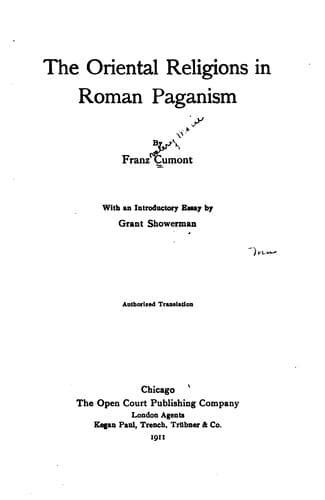
The Oriental Religions in Roman PaganismCumont, Franz
Religion
The Oriental Religions in Roman Paganism
Cumont, Franz
Paganism -- Rome; Religions; Rome -- Religion
5. Foucart, _Le culte de Dionysos en Attique_ (Extract from the _Mem. Acad.
Inscr._, XXXVII), 1904, pp. 22 ff.--The Thracians also seem to have spread,
in Asia Minor, the cult of the "riding god" which existed until the
beginning of the Roman period; cf. Remy, _Le Musee belge_, XI, 1907, pp.
136 ff.
6. Catullus, LXIII. {225}
7. The development of these mysteries has been well expounded by Hepding,
pp. 177 ff. (see Gruppe, _Gr. Myth._, p. 1544).--Ramsay has recently
commented upon inscriptions of Phrygian mystics, united by the knowledge of
certain secret signs ([Greek: tekmor]); cf. _Studies in the Eastern Roman
Provinces_, 1906, pp. 346 ff.
8. Dig., XLVIII, 8, 4, 2: "Nemo liberum servumve invitum sinentemve
castrare debet." Cf. Mommsen, _Strafrecht_, p. 637.
9. Diodorus, XXXVI, 6; cf. Plutarch, _Marius_, 17.
10. Cf. Hepding, _op. cit._, p. 142.
11. Cf. chap. VI.
12. Wissowa, _op. cit._, p. 291.
13. Hepding, _op. cit._, pp. 145 ff. Cf. Pauly-Wissowa, _Realenc._, s. v.
"Dendrophori," V, col. 216 and Suppl., col, 225, s. v. "Attis."
14. Cf. Tacitus, _Annales_, XI, 15.
15. This opinion has recently been defended by Showerman, _Classical
Journal_, II, 1906, p. 29.
16. Frazer, _The Golden Bough_, II^2, pp. 130 ff.
17. Hepding, pp. 160 ff. Cf. the texts of Ambrosiaster cited in _Rev. hist.
et litt. relig._, VIII, 1903, p. 423, n. 1.
18. Hepding, p. 193. Cf. Gruppe, p. 1541.
19. On this diffusion, cf. Drexler in Roscher, _Lexikon_, s. v. "Meter,"
col. 918.
20. Gregory of Tours, _De glor. confess._, c. 76. Cf. _Passio S.
Symphoriani_ in Ruinart, _Acta sinc._, ed. of 1859, p. 125. The _carpentum_
mentioned in these texts is found in Africa; cf. _CIL_, VIII, 8457, and
Graillot, _Rev. archeol._, 1904, I, p. 353; Hepding, op. cit., p. 173, n.
7.
21. [Greek: Tharreite mustai tou theou sesosmenou | hestai gar humin ek
ponon soteria]; cf. Hepding, op. cit., p. 167.--Attis has become a god
through his death (see Reitzenstein, _Poimandres_, p. 93), and in the same
way were his votaries to become the equals of the divinity through death.
The Phrygian epitaphs frequently have the character of dedications, and it
appears that the graves were grouped about the temple, see Ramsay,
_Studies_, pp. 65 ff., 271 ff., _passim_. {226}
22. Perdrizet, _Bull. corr. hell._, XIX, 1905, p. 534 ff.
23. We know of those beliefs of the Sabaziasts from the frescoes in the
catacombs of Praetextatus; the _Mercurius nuntius_, who leads the dead, is
found beside Attis under the Greek name of Hermes (see Hepding, p.
263).--Maybe the inscription _CIL_, VI, 509 = _Inscr. graec._, XIV, 1018,
should be completed: [Greek: Rheiei [Hermei] te genethloi]; cf. _CIL_, VI,
499. Hermes appears beside the Mother of the gods on a bas-relief by Ouchak
published by Michon, _Rev. des etudes anciennes_, 1906, p. 185, pl. II. See
also Mendel, "Musee de Brousse," _Bull. corr. hell._, 1909, p. 255.--The
Thracian Hermes is mentioned in Herodotus, see Maury, _Rel. de la Grece_,
III, p. 136.
Public-domain text, read in full here on John Shaqi.
Reviews
Reviews
No reviews yet
Be the first to share your thoughts on this work.
Elsewhere in the archive
Join the Discussion
Join the discussion
Sign in to leave a comment or review.
Sign InorCreate an account