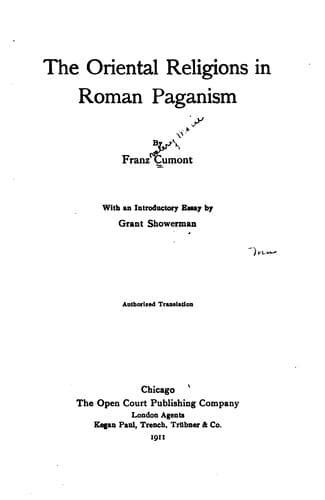
The Oriental Religions in Roman PaganismCumont, Franz
Religion
The Oriental Religions in Roman Paganism
Cumont, Franz
Paganism -- Rome; Religions; Rome -- Religion
24. Besides Bellona-Ma, subordinate to Cybele and Sabazius, who was as much
Jewish as Phrygian, there was only one god of Asia Minor, the Zeus Bronton
(the Thunderer) of Phrygia, prominently mentioned in Roman epigraphy. See
Pauly-Wissowa, _Realenc._, s. v. and Suppl. I, col. 258.
25. Cf. _CIL_, VI, 499: "Attidi menotyranno invicto." "Invictus" is the
characteristic epithet of the solar divinities.
26. P. Perdrizet, "Men" (_Bull. corr. hell._, XX), 1896; Drexler in
Roscher, _Lexikon_, s. v., II, col. 2687.
27. _CIL_, VI, 50 = _Inscr. graec._, XIV, 1018.
28. Schuerer, _Sitzungsb. Akad. Berlin_, XIII, 1897, p. 200 f. and our
_Hypsistos_ (Suppl. _Revue instr. publ. en Belgique_), 1897.
29. The term is taken from the terminology of the mysteries: the
inscription cited dates back to 370 A. D. In 364, in connection with
Eleusis, Agorius Praetextatus spoke of [Greek: sunechonta to anthropeion
genos hagiotata musteria] (Zozimus, IV, 3, 2). Earlier the "Chaldean
oracles" applied to the intelligible god the term [Greek: metra sunechousa
ta panta] (Kroll, _De orac. Chaldeicis_, p. 19).
30. Henri Graillot, _Les dieux Tout-Puissants, Cybele et Attis_ (_Revue
archeol._, 1904, I), pp. 331 ff.--Graillot is rather inclined to admit a
Christian influence, but _omnipotentes_ was used as a liturgic epithet in
288 A. D., and at about the same date Arnobius (VII, 32) made use of the
periphrasis _omnipotentia numina_ to designate the Phrygian gods, and he
{227} certainly was understood by all. This proves that the use of that
periphrasis was general, and that it must have dated back to a much earlier
period. As a matter of fact a dedication has been found at Delos, reading
[Greek: Dii toi panton kratounti kai Metri megalei tei panton kratousei]
(_Bull. corr. hellen._, 1882, p. 502, No. 25), that reminds the reader of
the [Greek: pantokrator] of the Septuagint; and Graillot (loc. cit., p.
328, n. 7) justly observes, in this connection, that on certain bas-reliefs
Cybele was united with the Theos Hypsistos, that is to say, the god of
Israel; see Perdrizet, _Bull. corr. hell._, XXIII, 1899, p. 598. On the
influence of Judaism on the cult of Men cf. Sam. Wide, _Archiv fuer
Religionsw._, 1909, p. 227.--On the omnipotence of the Syrian gods, see ch.
V, pp. 128 ff.
31. We are here giving the substance of a short essay on "Les mysteres de
Sabazius et le judaisme," published in the _Comptes Rendus Acad. Inscr._,
Febr. 9, 1906, pp. 63 ff. Cf. "A propos de Sabazius," _Musee belge_, XIV,
1910, pp. 56 ff.
32. Cf. _Monuments myst. de Mithra_, I, p. 333 f. The very early
assimilation of Cybele and Anahita justifies to a certain extent the
unwarranted practice of calling Cybele the Persian Artemis. See Radet,
_Revue des etudes anciennes_, X, 1908, p. 157. The pagan theologians often
considered Attis as the primeval man whose death brought about the
creation, and so they likened him to the Mazdean Gayomart, see Bousset,
_Hauptprobleme der Gnosis_, 1907, pp. 184 ff.
Public-domain text, read in full here on John Shaqi.
Reviews
Reviews
No reviews yet
Be the first to share your thoughts on this work.
Elsewhere in the archive
Join the Discussion
Join the discussion
Sign in to leave a comment or review.
Sign InorCreate an account