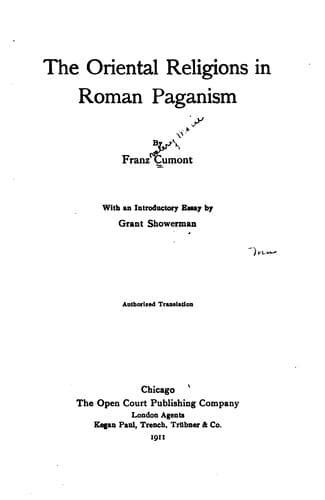
The Oriental Religions in Roman PaganismCumont, Franz
Religion
The Oriental Religions in Roman Paganism
Cumont, Franz
Paganism -- Rome; Religions; Rome -- Religion
5. Diogenes Laertius, V, 5, Sec. 76: [Greek: Hothen kai tous paianas poiesai
tous mechri nun haidomenous]. The [Greek: mechri nun] Diogenes took
undoubtedly from his source, Didymus. See Artemidorus, _Onirocr._, II, 44
(p. 143, 25 Hercher).--This information is explicitly confirmed by an
inscription which mentions [Greek: he hiera taxis ton paianiston] (_Inscr.
Graec._, XIV, 1034).
6. Kaibel, _Epigr._ 1028 = Abel, _Orphica_, p. 295, etc.--See _supra_, ch.
I, n. 14.--According to recent opinion, M. de Wilamowitz was good enough to
write me, the date of the Andros hymn cannot have been later than the
period of Cicero, and it is very probably contemporary with Sulla.--See
_supra_, ch. I, n. 14.--On other similar texts, see Gruppe, _Griech.
Mythol._, P. 1563.
7. Amelung, _Le Serapis de Bryaxis_ (_Revue archeol_, 1903, II), p. 178.
8. P. Foucart, _Le culte de Dionysos en Attique_ (_Mem. Acad. des Inscr._,
XXXVII), 1904. On the Isis cult in ancient Greece, we can now refer to
Gruppe, _Griech. Myth._, pp. 1565 ff.; Ruhl, _De Sarapide et Iside in
Graecia cultis_ (Diss. Berlin) 1906, has made careful use of the epigraphic
texts dating back to the time before the Roman period.
9. The only exception is the Zeus Ammon, who was only half Egyptian and
owed his very early adoption to the Greek colonies of Cyrene; see Gruppe,
_Griech. Myth._, p. 1558. The addition of other goddesses, like Nephtis or
Bubastis to Isis is exceptional.
10. Concerning the impression which Egypt made on travelers, see
Friedlaender, _Sittengesch._, II^6, 144 ff.; Otto, _Priester und Tempel_,
II, p. 210.
11. Juvenal, XV, 10, and the notes of Friedlaender on these passages.--The
Athenian comic writers frequently made fun of the Egyptian zoolatry
(Lafaye, _op. cit._, p. 32). Philo of Alexandria considered the Egyptians
as the most idolatrous heathens and he attacked their animal worship, in
particular {231} (_De Decal._, 16, II, p. 193 M., and _passim_). The pagan
writers were no less scandalized (Cicero, _Nat. deor._, III, 15, etc.)
except where they preferred to apply their ingenuity to justify it. See
Dill, _loc. cit._, p. 571.--The features of this cult in ancient Egypt have
been recently studied by George Foucart, _Revue des idees_, Nov. 15, 1908,
and _La methode comparative et l'histoire des religions_, 1909, pp. 43 ff.
12. Macrobius, _Sat._, I, 20, Sec. 16.
13. Holm, _Gesch. Siziliens_, I, p. 81.
14. Libanius, Or., XI, 114 (I, p. 473 Foerster). Cf. Drexler in Roscher,
_op. cit._, col. 378.
15. Pausan., I, 18, 4: [Greek: Sarapidos hon para Ptolemaiou theon
eisegagonto]. Ruhl (op. cit., p. 4) attaches no historic value to this
text, but, as he points out himself, we have proof that an official Isis
cult existed at Athens under Ptolemy Soter, and that Serapis was worshiped
in that city at the beginning of the third century.
16. Dittenberger, _Or. gr. inscr. sel._, No. 16.
17. Apul., _Metam._, XI, 17.
Public-domain text, read in full here on John Shaqi.
Reviews
Reviews
No reviews yet
Be the first to share your thoughts on this work.
Elsewhere in the archive
Join the Discussion
Join the discussion
Sign in to leave a comment or review.
Sign InorCreate an account