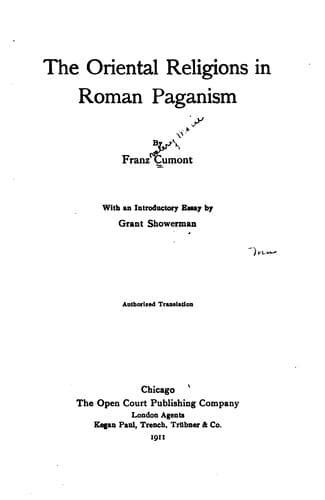
The Oriental Religions in Roman PaganismCumont, Franz
Religion
The Oriental Religions in Roman Paganism
Cumont, Franz
Paganism -- Rome; Religions; Rome -- Religion
55. Cf. G. Hock, _Griechische Weihegebraeuche_, 1905, pp. 65 ff. Ps.-Apul.,
_Asclep._, 23: "Homo fictor est deorum qui in templis sunt et non solum
inluminatur, verum etiam inluminat"; c. 37: "Proavi invenerunt artem qua
efficerent deos." Cf. George Foucart, _loc. cit._ [n. 61]: "La statuaire
egyptienne a, avant tout autre, le caractere de creer des etres vivants."
56. Maspero, _Sur la toute-puissance de la parole_ (_Recueil de travaux_,
XXIV), 1902, pp. 163-175; cf. my _Recherches sur le manicheisme_, p. 24, n.
2.--The parallelism between the divine and the sacerdotal influence is
established in Ps.-Apul., _Asclepius_, 23.
57. Iamblichus, _Myst._, VI, 6; cf. G. Foucart, _La methode comparative et
l'histoire des religions_, 1909, p. 131, 141, 149 ff. and infra, n. 66. The
Egyptians prided themselves on having been the first "to know the sacred
names and to use the sacred speech" (Luc., _De Dea Syr._, 1).
58. This has been proven by Otto, _Priester und Tempel_, I, pp. 114 ff. Cf.
_supra_, chap. II, n. 35. Certain busts have recently inspired Mr. Dennison
to give his attention to the tonsure of the votaries of Isis (_American
Journ. of Archeology_, V, 1905, p. 341). The Pompeian frescoes representing
priests and ceremonies of the Isis cult are particularly important for our
knowledge of the liturgy (Guimet, _C. R. Acad. des Inscr._, 1896, pls.
VII-IX. Cf. von Bissing, _Transact. congr. relig. Oxford_, 1908, I, pp. 225
ff.).
59. _CIL_, XII, 3061: "Ornatrix fani."
60. Cf. Kan, _De Iove Dolicheno_, 1901, p. 33.
61. Cf. Moret, _Le rituel du culte divin journalier en Egypte_, Paris,
1902. Just as the ritual of consecration brought the statue to life
(_supra_, n. 55), the repeated sacrifices sustained life, and made it
_longa durare per tempora_ (Ps.-Apul., _Asclep._, 38). The epithet of
[Greek: aeizoos], given to several divinities (_CIG_, 4598; _Griech.
Urkunden_ of Berlin, I, No. 124), expresses it exactly. All this is in
conformity with the old ideas prevailing in the valley of the Nile (see
George Foucart, _Revue des {236} idees_, Nov. 15, 1908).--When compared
with the Egyptian ceremonial, the brief data scattered through the Greek
and Latin authors become wonderfully clear and coherent.
62. Apul., XI, 22: "Rituque sollemni apertionis celebrato ministerio." Cf.
XI, 20: "Matutinas apertiones templi."
63. Jusephus, _Ant. Jud._, XVIII, 3, 5, Sec. 174.
64. Servius ad Verg., _Aen._, IV, 512: "In templo Isidis aqua sparsa de
Nilo esse dicebatur"; cf. II, 116. When, by pouring water taken from the
river, reality took the place of this fiction, the act was much more
effective; see Juv. VII, 527.
65. This passage, together with a chapter from Apuleius (XI, 20), is the
principal text we have in connection with the ritual of those Isis matins.
(_De Abstin._, IV, 9):
Public-domain text, read in full here on John Shaqi.
Reviews
Reviews
No reviews yet
Be the first to share your thoughts on this work.
Elsewhere in the archive
Join the Discussion
Join the discussion
Sign in to leave a comment or review.
Sign InorCreate an account