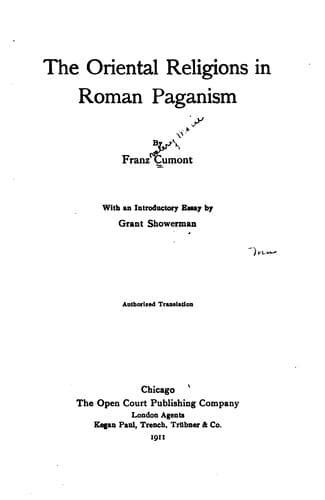
The Oriental Religions in Roman PaganismCumont, Franz
Religion
The Oriental Religions in Roman Paganism
Cumont, Franz
Paganism -- Rome; Religions; Rome -- Religion
91. The Egyptian origin of the Christian expression has frequently been
pointed out and cannot be doubted; see Lafaye, _op. cit._, p. 96, n. 1;
Rohde, _Psyche_, II, p. 391; Kraus, _Realencycl. der christl. Alt._, s. v.
"Refrigerium"; and especially Dieterich, _Nekyia_, pp. 95 ff. Cf.
Perdrizet, _Rev. des etudes anc._, 1905, p. 32; Audollent, _Melanges Louis
Havet_, 1909, p. 575.--The _refrigerii sedes_, which the Catholic Church
petitions for the deceased in the anniversary masses, appears in the oldest
Latin liturgies, and the Greeks, who do not believe in purgatory, have
always expressed themselves along the same lines. For instance, Nubian
inscriptions which are in perfect agreement with the euchology of
Constantinople hope the soul will rest [Greek: en topoi chloeroi, en topoi
anapsuxeos] (G. Lefebvre, _Inscr. gr. chret. d'Eg._, No. 636, 664 ff., and
introd., p. xxx; cf. Dumont, _Melanges_, Homolle ed., pp. 585 ff.). The
detail is not without significance because it furnishes a {240} valuable
indication as to the Egyptian origin of prayer for the dead; this is
unknown to Graeco-Roman paganism which prayed to the deified dead but never
_for_ the dead as such. The Church took this custom from the Synagogue, but
the Jews themselves seem to have taken it from the Egyptians during the
Hellenistic period, undoubtedly in the course of the second century (S.
Reinach, _Cultes, mythes_, I, p. 325), just as they were indebted to the
Egyptians for the idea of the "spring of life" (_supra_, n. 90). The
formula in the Christian inscriptions cited,
[Greek: anapauson ten psuchen en kolpois Abraam kai Isaak kai Iakob],
appears to indicate a transposition of the doctrine of identification with
Osiris. In this way we can explain the persistence in the Christian
formulary of expressions, like _requies aeterna_, corresponding to the most
primitive pagan conceptions of the life of the dead, who were not to be
disturbed in their graves.--A name for the grave, which appears frequently
in Latin epitaphs, viz., _domus aeterna_ (or _aeternalis_) is undoubtedly
also of Egyptian importation. In Egypt, "la tombe est la maison du mort, sa
maison d'eternite, comme disent les textes" (Capart, _Guide du musee de
Bruxelles_, 1905, p. 32). The Greeks were struck by this expression which
appears in innumerable instances. Diodorus of Sicily (I, 51, Sec. 2) was aware
that the Egyptians
[Greek: tous ton teteleutekoton taphous aidious oikous prosagoreuousin, hos
en Haidou diatelounton ton apeiron aiona] (cf. I, 93, Sec. 1, [Greek: eis ten
aionion oikesin]).--
Public-domain text, read in full here on John Shaqi.
Reviews
Reviews
No reviews yet
Be the first to share your thoughts on this work.
Elsewhere in the archive
Join the Discussion
Join the discussion
Sign in to leave a comment or review.
Sign InorCreate an account