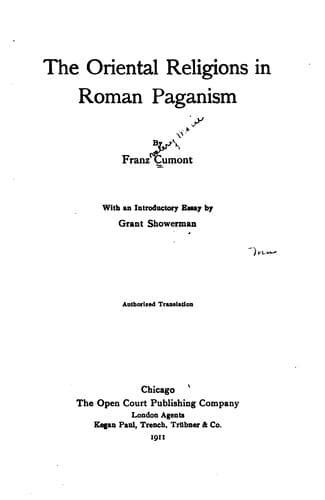
The Oriental Religions in Roman PaganismCumont, Franz
Religion
The Oriental Religions in Roman Paganism
Cumont, Franz
Paganism -- Rome; Religions; Rome -- Religion
16. Adonis: Wissowa, p. 300, n. 1.--Balmarcodes: Pauly-Wissowa, _Realenc._,
s. v.; Jalabert, _Mel. fac. orient. Beyrouth_, I, p. 182.--Marnas: The
existence at Ostia of a "Marneum" can be deduced from the dedication _CIG_,
5892 (cf. Drexler in Roscher, _Lexikon_, s. v., col. 2382).--On
Maleciabrudus, cf. _supra_, n. 10.--The Maiuma festival was probably
introduced with the cult of the god of Gaza, Lydus, _De Mensib._, IV, 80
(p. 133, Wuensch ed.) = Suidas s. v. [Greek: Maioumas] and Drexler, _loc.
cit._, col. 2287. Cf. Clermont-Ganneau, _Rec. d'archeol. orient._, IV, p.
339.
17. Cf. Pauly-Wissowa, s. v. "Damascenus, Dusares."
18. Malalas, XI, p. 280, 12 (Bonn).--The temple has recently been excavated
by a German mission; cf. Puchstein, _Fuehrer in Baalbek_, Berlin, 1905.--On
the Hadad at Rome, cf. _supra_, n. 10.
19. _CIL_, X, 1634: "Cultores Iovis Heliopolitani Berytenses qui Puteolis
consistunt"; cf. Wissowa, _loc. cit._, p. 504, n. 3; Ch. Dubois, _Pouzzoles
antique_, Paris, 1906, p. 156.
20. A list of the known military societies has been made by Cichorius in
Pauly-Wissowa, _Realencycl._, s. v. "Ala" and "Cohors."
21. _CIL_, VII, 759 = Buecheler, _Carmina epigr._, 24. Two inscriptions
dedicated to the Syrian Hercules (Melkarth) and to Astarte have been
discovered at Corbridge, near Newcastle (_Inscr. gr._, XIV, 2553). It is
possible that Tyrian archers were cantoned there.
22. Baltis: Pauly-Wissowa, _Realencyclop._, s. v.
23. Pauly-Wissowa, _Realenc._, s. v. "Aziz"; cf. Wissowa, _op. cit._, p.
303, n. 7.
24. On the etymology of Malakbel, see Dussaud, _Notes_, 24 ff. On the
religion in the Occident see Edu. Meyer in Roscher, _Lexikon_, s. v. {244}
25. Kan, _De Iovis Dolicheni cultu_, Groningen, 1901; cf. Pauly-Wissowa,
_Realencycl._, s. v. "Dolichenus."
26. Reville, _Relig. sous les Severes_, pp. 237 ff.; Wissowa, _op. cit._,
p. 305; cf. Pauly-Wissowa, s. v. "Elagabal."--In a recent article (_Die
politische Bedeutung der Religion von Emesa_ [_Archiv fuer Religionsw._,
XI], 1908, pp. 223 ff.) M. von Domaszewski justly lays stress on the
religious value of the solar monotheism that arose in the temples of Syria,
but he attributes too important a part in its formation to the clergy of
Emesa (see _infra_, n. 88). The preponderant influence seems to have been
exercised by Palmyra (see _infra_, n. 59).
27. Cf. _infra_, n. 59.
28. Cf. Curtiss, _Primitive Semitic Religion To-day_, Chicago, 1902;
Jaussen, _Coutumes des Arabes du pays de Moab_, Paris, 1908, pp. 297 ff.
Public-domain text, read in full here on John Shaqi.
Reviews
Reviews
No reviews yet
Be the first to share your thoughts on this work.
Elsewhere in the archive
Join the Discussion
Join the discussion
Sign in to leave a comment or review.
Sign InorCreate an account