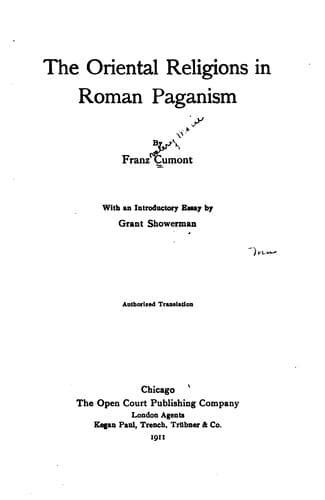
The Oriental Religions in Roman PaganismCumont, Franz
Religion
The Oriental Religions in Roman Paganism
Cumont, Franz
Paganism -- Rome; Religions; Rome -- Religion
It would be impossible to admit that like causes produce like results, and
then maintain that a similarity is not sufficient proof of an influence in
history. Wherever we can closely follow the successive transformations of a
particular institution, we notice the action of the Orient and especially
of Egypt. When Rome had become a great cosmopolitan metropolis like
Alexandria, Augustus reorganized it in imitation of the capital of the
Ptolemies. The fiscal reforms of the Caesars like the taxes on sales and
inheritances, the register of land surveys and the direct collection of
taxes, were suggested by the very perfect financial system of the
Lagides,[5] and it can be maintained that their government was the first
source from which those of modern Europe were derived, through the medium
{5} of the Romans. The imperial _saltus_, superintended by a procurator and
cultivated by metayers reduced to the state of serfs, was an imitation of
the ones that the Asiatic potentates formerly cultivated through their
agents.[6] It would be easy to increase this list of examples. The absolute
monarchy, theocratic and bureaucratic at the same time, that was the form
of government of Egypt, Syria and even Asia Minor during the Alexandrine
period was the ideal on which the deified Caesars gradually fashioned the
Roman empire.
One cannot however deny Rome the glory of having elaborated a system of
private law that was logically deduced from clearly formulated principles
and was destined to become the fundamental law of all civilized
communities. But even in connection with this private law, where the
originality of Rome is uncontested and her preeminence absolute, recent
researches have shown with how much tenacity the Hellenized Orient
maintained its old legal codes, and how much resistance local customs, the
woof of the life of nations, offered to unification. In truth, unification
never was realized except in theory.[7] More than that, these researches
have proved that the fertile principles of that provincial law, which was
sometimes on a higher moral plane than the Roman law, reacted on the
progressive transformation of the old _ius civile_. And how could it be
otherwise? Were not a great number of famous jurists like Ulpian of Tyre
and Papinian of Hemesa natives of Syria? And did not the law-school of
Beirut constantly grow in importance after the third century, until during
the fifth century it became the most brilliant center of legal education?
Thus Levantines {6} cultivated even the patrimonial field cleared by
Scaevola and Labeo.[8]
Public-domain text, read in full here on John Shaqi.
Reviews
Reviews
No reviews yet
Be the first to share your thoughts on this work.
Join the Discussion
Join the discussion
Sign in to leave a comment or review.
Sign InorCreate an account