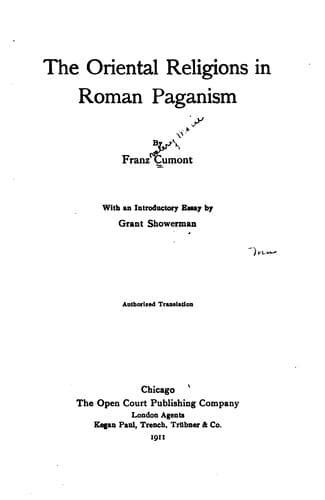
The Oriental Religions in Roman PaganismCumont, Franz
Religion
The Oriental Religions in Roman Paganism
Cumont, Franz
Paganism -- Rome; Religions; Rome -- Religion
70. On the worship of Baalsamin, confused with Ahura-Mazda and transformed
into _Caelus_, see _Mon. myst. Mithra_, p. 87.--The texts attesting the
existence of a real cult of {257} heaven among the Semites are very
numerous. Besides the ones I have gathered (_loc. cit._, n. 5); see
Conybeare, _Philo about the Contemplative Life_, p. 33, n. 16; Kayser, _Das
Buch der Erkenntniss der Wahrheit_, 1893, p. 337, and _infra_, n. 75. Zeus
[Greek: Ouranios]: Le Bas-Waddington, 2720 _a_ (Baal of Betocece); Renan,
_Mission de Phenicie_, p. 103.--Cf. _Archiv fuer Religionswissenschaft_, IX,
1906, p. 333.
71. Coins of Antiochus VIII Grypus (125-96 B. C.); Babelon, _Rois de Syrie,
d'Armenie_, 1890, p. CLIV, pp. 178 ff.
72. All these qualities ascribed to the Baals by astrological paganism
([Greek: hupsistos, pantokrator], etc.), are also the attributes which,
according to the doctrine of Alexandrian Judaism, characterized Jehovah
(see _supra_, n. 66). If he was originally a god of thunder, as has been
maintained, the evolution of the Jewish theology was parallel to that of
the pagan conceptions (see _supra_, n. 69).
73. On this subject cf. _Jupiter summus exsuperantissimus_ (_Archiv f.
Religionsw._, IX), 1906, pp. 326 ff.
74. Ps.-Iamblichus, _De mysteriis_, VI, 7 (cf. Porph., _Epist. Aneb._, c.
29), notes this difference between the two religions.
75. Apul., _Met._, VIII, 25. Cf. _CIL_, III, 1090; XII, 1227 (= Dessau,
2998, 4333); Macrobius, _Comm. somn. Scipionis_, I, 14, Sec. 2: "Nihil aliud
esse deum nisi caelum ipsum et caelestia ipsa quae cernimus, ideo ut summi
omnipotentiam dei ostenderet posse vix intellegi."--[Greek: Helios
pantokratos]: Macrob., I, 23, 21.
76. Diodorus, II, 30: [Greek: Chaldaioi ten tou kosmou phusin aidion phasin
einai k. t. l.]; cf. Cicero, _Nat. deor._, II, 20, Sec. 52 ff.; Pliny, _H.
N._, II, 8, Sec. 30. The notion of eternity was correlative with that of
[Greek: heimarmene]; cf. Ps.-Apul., _Asclep._, 40; Apul., _De deo
Socratis_, c. 2: "(The planets) quae in deflexo cursu ... meatus aeternos
divinis vicibus efficiunt."--This subject will be more fully treated in my
lectures on "Astrology and Religion" (chaps. IV-V).
77. At Palmyra: De Voguee, _Inscr. sem._, pp. 53 ff., etc.--On the first
title, see _infra_, n. 80.
78. Note especially _CIL_, VI, 406 = 30758, where Jupiter Dolichenus is
called _Aeternus conservator totius poli_. The {258} relation to heaven
here remained apparent. See _Somn. Scip._, III, 4; IV, 3.
79. Cf. _Rev. archeol._, 1888, I, pp. 184 ff.; Pauly-Wissowa, s. v.
"Aeternus," and _Festschrift fuer Otto Benndorf_, 1898, p. 291.--The idea of
the eternity of the gods also appeared very early in Egypt, but it does not
seem that the mysteries of Isis--in which the death of Osiris was
commemorated--made it prominent, and it certainly was spread in the
Occident only by the sidereal cults.
Public-domain text, read in full here on John Shaqi.
Reviews
Reviews
No reviews yet
Be the first to share your thoughts on this work.
Elsewhere in the archive
Join the Discussion
Join the discussion
Sign in to leave a comment or review.
Sign InorCreate an account