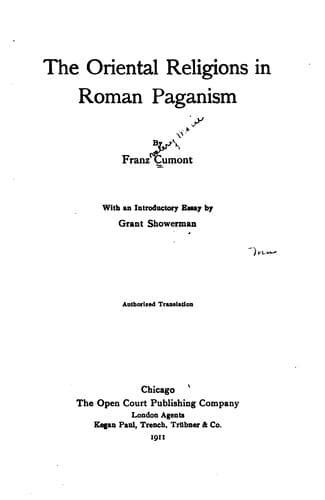
The Oriental Religions in Roman PaganismCumont, Franz
Religion
The Oriental Religions in Roman Paganism
Cumont, Franz
Paganism -- Rome; Religions; Rome -- Religion
80. The question has been raised whether the epithet [Hebrew: MR' `LM']
means "lord of the world" or "lord of eternity" (cf. Lidzbarski,
_Ephemeris_, I, 258; II, 297; Lagrange, p. 508), but in our opinion the
controversy is to no purpose, since in the spirit of the Syrian priests the
two ideas are inseparable and one expression in itself embraces both, the
world being conceived as eternal (_supra_, n. 76). See for Egypt,
Horapoll., _Hieroglyph._, I (serpent as symbol of the [Greek: aion] and
[Greek: kosmos]). At Palmyra, too, the title "lord of all" is found,
[Hebrew: MR' KL] (Lidzbarski, _loc. cit._); cf. Julian, Or., IV, p. 203, 5
(Hertlein): [Greek: Ho basileus ton holon Helios], and infra, n. 81; n. 87.
Already at Babylon the title "lord of the universe" was given to Shamash
and Hadad; see Jastrow, _Religion Babyloniens_, I, p. 254, n. 10. Noeldeke
has been good enough to write me as follows on this subject: "Daran kan
kein Zweifel sein, dass [Hebrew: `LM] zunaechst (lange Zeit) Ewigkeit
heisst, und dass die Bedeutung 'Welt' secundaer ist. Ich halte es daher fuer
so gut wie gewiss dass das palmyrenische [Hebrew: MR' `LM'], wenn es ein
alter Name ist, den 'ewigen' Herrn bedeutet, wie ohne Zweifel [Hebrew: 'L
`WLM], Gen., xxi. 33. Das biblische Hebraeisch kennt die Bedeutung 'Welt'
noch nicht, abgesehen wohl von der spaeten Stelle, Eccl. iii. 11. Und, so
viel ich sehe, ist im Palmyrenischen sonst [Hebrew: `LM'] immer 'Ewigkeit,'
z.B. in der haeufigen Redensart [Hebrew: LBRYK SHMCH L`LM']. Aber das
daneben vorkommende palmyr. [Hebrew: MR' KL] fuehrt allerdings darauf, dass
die palmyrenische Inschrift auch in [Hebrew: MR' `LM'] den 'Herrn der Welt'
sah. Ja der syrische Uebersetzer sieht auch in jenem hebraeischen [Hebrew:
'L `WLM] 'den Gott der Welt.' Das Syrische hat naemlich einen formalen
Unterschied festgestellt zwischen _'[=a]l[)a]m_, dem Status absolutus,
'Ewigkeit,' und _'[=a]lm[=a]_ [_[=a]l^em[=a]_] dem Status emphaticus
'Welt.'--Sollte uebrigens die {259} Bedeutung Welt diesem Worte erst durch
Einfluss griechischer Speculation zu Teil geworden sein? In der
Zingirli-Inschrift bedeuted [Hebrew: BTSLM] noch bloss 'in seiner Zeit.'"
81. Cf. _CIL_, III, 1090 = Dessau, _Inscr._, 2998: "Divinarum humanarumque
rerum rectori." Compare _ibid._, 2999 and Cagnet, _Annee epigr._, 1905, No.
235: "I. O. M., id est universitatis principi." Cf. the article of the
_Archiv_ cited, n. 73. The _Asclepius_ says (c. 39), using an astrological
term: "Caelestes dii catholicorum dominantur, terreni incolunt singula."
82. Cf. W. Robertson Smith, 75 ff., _passim_. In the Syrian religions as in
that of Mithra, the initiates regarded each other as members of the same
family, and the phrase "dear brethren" as used by our preachers, was
already in use among the votaries of Jupiter Dolichenus (_fratres
carissimos_, _CIL_, VI, 406 = 30758).
Public-domain text, read in full here on John Shaqi.
Reviews
Reviews
No reviews yet
Be the first to share your thoughts on this work.
Elsewhere in the archive
Join the Discussion
Join the discussion
Sign in to leave a comment or review.
Sign InorCreate an account