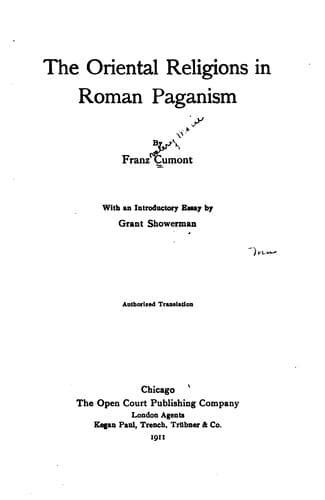
The Oriental Religions in Roman PaganismCumont, Franz
Religion
The Oriental Religions in Roman Paganism
Cumont, Franz
Paganism -- Rome; Religions; Rome -- Religion
16. In the _Studio Pontica_, p. 368, I have described a grotto located near
Trapezus and formerly dedicated to Mithra, but now transformed into a
church. We know of no other Mithreum. A bilingual dedication to Mithra, in
Greek and Aramaic, is engraved upon a rock in a wild pass near Farasha
(Rhodandos) in Cappadocia. Recently it has been republished {263} with
excellent notes by Henri Gregoire (_Comptes Rendus Acad. des Inscr._, 1908,
pp. 434 ff.), but the commentator has mentioned no trace of a temple. The
text says that a strategus from Ariaramneia [Greek: emageuse Mithrei].
Perhaps these words must be translated according to a frequent meaning of
the aorist, by "became a magus of Mithra" or "began to serve Mithra as a
magus." This would lead to the conclusion that the inscription was made on
the occasion of an initiation. The magus dignity was originally hereditary
in the sacred caste; strangers could acquire it after the cult had assumed
the form of mysteries. If the interpretation offered by us is correct the
Cappadocian inscription would furnish interesting evidence of that
transformation in the Orient. Moreover, we know that Tiridates of Armenia
initiated Nero; see _Mon. myst. Mithra_, I, p. 239.
17. Strabo, XI, 14, Sec. 9. On the studs of Cappadocia, cf. Gregoire, _Saints
jumeaux et dieux cavaliers_, 1905, pp. 56 ff.
18. Cf. _C. R. Acad. des Inscr._, 1905, pp. 99 ff. (note on the bilingual
inscription of Aghatcha-Kale); cf. Daremberg-Saglio-Pottier, _Dict.
Antiqu._, s. v. "Satrapa."
19. _Mon. myst. Mithra_, I, p. 10, n. 1. The argument undoubtedly dates
back to Carneades, see Boll, _Studien ueber Claudius Ptolemaeus_, 1894, pp.
181 ff.
20. Louis H. Gray (_Archiv fuer Religionswiss._, VII, 1904, p. 345) has
shown how these six Amshaspands passed from being divinities of the
material world to the rank of moral abstractions. From an important text of
Plutarch it appears that they already had this quality in Cappadocia; cf.
_Mon. myst. Mithra_, II, p. 33, and Philo, _Quod omn. prob. lib._, 11 (II,
456 M).--On Persian gods worshiped in Cappadocia, see _Mon. myst. Mithra_,
I, p. 132.
21. See _supra_, n. 16 and 18.--According to Gregoire, the bilingual
inscription of Farasha dates back to the first century, before or after
Christ (_loc. cit._, p. 445).
22. _Mon. myst. Mithra_, I, p. 9, n. 5.
23. Comparison of the type of Jupiter Dolichenus with the bas-reliefs of
Boghaz-Keui led Kan (_De Iovis Dolicheni cultu_, Groningen, 1901, pp. 3
ff.) to see an Anatolian god in him. {264} The comparison of the formula
_ubi ferrum nascitur_ with the expression [Greek: hopou ho sideros
tiktetai], used in connection with the Chalybians, leads to the same
conclusion, see _Revue de philologie_, XXVI, 1902, p. 281.--Still, the
representations of Jupiter Dolichnus also possess a remarkable resemblance
to those of the Babylonian god Ramman; cf. Jeremias in Roscher, _Lexikon
der Myth._, s. v. "Ramman," IV, col. 50 ff.
Public-domain text, read in full here on John Shaqi.
Reviews
Reviews
No reviews yet
Be the first to share your thoughts on this work.
Elsewhere in the archive
Join the Discussion
Join the discussion
Sign in to leave a comment or review.
Sign InorCreate an account