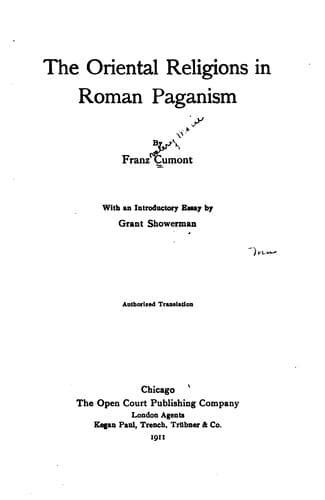
The Oriental Religions in Roman PaganismCumont, Franz
Religion
The Oriental Religions in Roman Paganism
Cumont, Franz
Paganism -- Rome; Religions; Rome -- Religion
24. _Rev. archeol._ 1905, I, p. 189. Cf. _supra_, p. 127, n. 68.
25. Herod., I, 131.--On the assimilation of Baalsamin to Ahura-Mazda, cf.
_supra_, p. 127, and _infra_, n. 29. At Rome, Jupiter Dolichenus was
_conservator totius poli et numen praestantissimum_ (_CIL_, VI, 406 =
30758).
26. Inscription of King Antiochus of Commagene (Michel, _Recueil_, No.
735), l. 43:
[Greek: Pros ouranious Dios Oromasdou thronous theophile psuchen
propempsan]; cf. l. 33: [Greek: Ouranion anchista thronon].
27. _Mon. myst. Mithra_, I, p. 87.
28. _Mon. myst. Mithra_, I, p. 333.--An inscription discovered in a
mithreum at Dorstadt (Sacidava in Dacia, _CIL_, III, 7728, cf. 7729),
furnishes, if I rightly understand, another proof of the relation existing
between the Semitic cults and that of the Persian gods. It speaks of a
"de[orum?] sacerdos creatus a Pal[myr]enis, do[mo] Macedonia, et adven[tor]
huius templi." This rather obscure text becomes clear when compared with
Apul., _Metam._, XI, 26. After the hero had been initiated into the
mysteries of Isis in Greece, he was received at Rome in the great temple of
the Campus Martius, "fani quidem advena, religionis autem indigena." It
appears also that this Macedonian, who was made a priest of their national
gods (Bel, Malakbel, etc.) by a colony of Palmyrenians, was received in
Dacia by the mystics of Mithra as a member of their religion.
29. At Venasa in Cappadocia, for instance, the people, even during the
Christian period, celebrated a panegyric on a mountain, where the celestial
Zeus, representing Baalsamin and Ahura-Mazda, was formerly worshiped
(Ramsay, _Church in the Roman Empire_, 1894, pp. 142, 457). The
identification of Bel with Ahura-Mazda in Cappadocia results from the
Aramaic inscription of Jarpuz (Clermont-Ganneau, _Recueil_, III, {265} p.
59; Lidzbarski, _Ephemeris fuer semit. Epigraphik_, I, pp. 59 ff.). The Zeus
Stratios worshiped upon a high summit near Amasia was in reality
Ahura-Mazda, who in turn probably supplanted some local god (_Studia
Pontica_, pp. 173 ff.).--Similarly the equation Anahita = Ishtar = Ma or
Cybele for the great female divinity is accepted everywhere (_Mon. myst.
Mithra_, I, p. 333), and Ma takes the epithet [Greek: aniketos] like Mithra
(_Athen. Mitt._, XVIII, 1893, p. 415, and XXIX, 1904, p. 169). A temple of
this goddess was called [Greek: hieron Astartes] in a decree of Anisa
(Michel, _Recueil_, No. 536, l. 32).
30. The Mithra "mysteries" are not of Hellenic origin (_Mon. myst. Mithra_,
I, p. 239), but their resemblance to those of Greece, which Gruppe insists
upon (_Griech. Mythologie_, pp. 1596 ff.) was such that the two were bound
to become confused in the Alexandrian period.
Public-domain text, read in full here on John Shaqi.
Reviews
Reviews
No reviews yet
Be the first to share your thoughts on this work.
Elsewhere in the archive
Join the Discussion
Join the discussion
Sign in to leave a comment or review.
Sign InorCreate an account