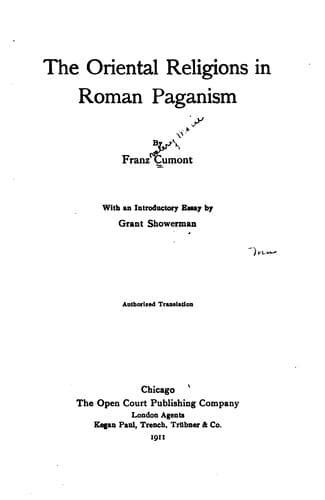
The Oriental Religions in Roman PaganismCumont, Franz
Religion
The Oriental Religions in Roman Paganism
Cumont, Franz
Paganism -- Rome; Religions; Rome -- Religion
39. Porphyry, _De Abstin._, II, 37-43, expounds a theory about the demons,
which, he says, he took from "certain Platonists" ([Greek: Platonikoi
tines], Numenius and Cronius?). That these authors, whoever they were,
helped themselves freely to the doctrines of the magi, seems to appear
immediately from the whole of Porphyry's exposition (one could almost give
an endless commentary on it with the help of the Mazdean books) and in
particular from the mention that is made of a power commanding the spirits
of evil (see _supra_, n. 37). This conclusion is confirmed by a comparison
with the passage of Arnobius cited above (n. 36), who attributes similar
theories to the "magi," and with a chapter of the Ps.-Iamblichus (_De
mysteriis_, III, 31) which develops analogous beliefs as being those of
"Chaldean prophets."--Porphyry also cites a "Chaldean" theologian in
connection with the influence of the demons, _De regressu animae_ (Aug.,
_Civ. Dei_, X, 9).
I conjecture that the source of all this demonology is the book attributed
to Hostanes which we find mentioned in the second century of our era by
Minucius Felix, St. Cyprian (_supra_, n. 38), etc.; cf. Wolff, op. cit., p.
138; _Mon. myst. Mithra_, I, p. 33. As a matter of fact it would be false
logic to try to explain the evolution of demonology, which is above
everything else religious, by the development of the philosophic theories
of the Greeks (see for instance the communications of Messrs. Stock and
Glover: _Transactions of the Congress of {268} History of Rel._, Oxford,
1908, II, pp. 164 ff.). The influence of the popular Hellenic or foreign
ideas has always been preponderant here; and the Epinomis, which contains
one of the oldest accounts of the theory of demons, as proved _supra_, n.
34, was influenced by the Semitic notions about genii, the ancestors of the
_djinns_ and the _welys_ of Islam.
If, as we believe, the text of Porphyry really sets forth the theology of
the magi, slightly modified by Platonic ideas based on popular beliefs of
the Greeks and perhaps of the barbarians, we shall be able to draw
interesting conclusions in regard to the mysteries of Mithra. For instance,
one of the principles developed is that the gods must not be honored by the
sacrifice of animated beings ([Greek: empsucha]), and that immolation of
victims should be reserved for the demons. The same idea is found in
Cornelius Labeo, (Aug., _Civ. Dei_, VIII, 13; see Arnobius, VII, 24), and
possibly it was the practice of the Mithra cult. Porphyry (II, 36) speaks
in this connection of rites and mysteries, but without divulging them, and
it is known that in the course of its history Mazdaism passed from the
bloody to the bloodless sacrifice (_Mon. myst. Mithra_, I, p. 6).
40. Cf. Plutarch, _De defectu orac._, 10, p. 415 A:
Public-domain text, read in full here on John Shaqi.
Reviews
Reviews
No reviews yet
Be the first to share your thoughts on this work.
Elsewhere in the archive
Join the Discussion
Join the discussion
Sign in to leave a comment or review.
Sign InorCreate an account