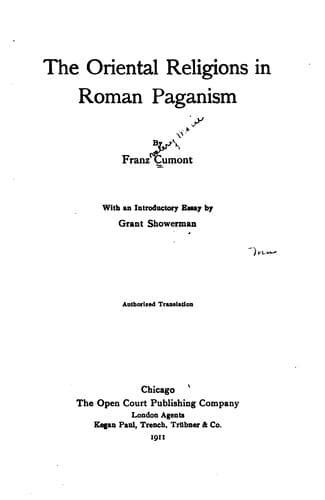
The Oriental Religions in Roman PaganismCumont, Franz
Religion
The Oriental Religions in Roman Paganism
Cumont, Franz
Paganism -- Rome; Religions; Rome -- Religion
11. Chapter [Greek: Peri deipnou]: _Cat. codd. astr._, IV, p. 94. The
precept: "Ungues Mercurio, barbam Iove, Cypride crinem," {272} ridiculed by
Ausonius, (VII, 29, p. 108, Piper) is well known. There are many chapters
[Greek: Peri onuchon, Peri himation], etc.
12. _Cat. codd. astr._, V, 1 (Rom.) p. 11, cod. 2, f. 34: [Greek: Peri tou
ei echei megan rhina ho gennetheis. Poteron porne genetai he gennetheisa.]
13. Varro, _De re rustica_, I, 37, 2; cf. Pliny, _Hist. nat._, XVI, 75,
Sec. 194. Olympiod, _Comm. in Alcibiad Plat._, p. 18 (ed. Creuzer, 1821):
[Greek: Tous hieratikos zontas estin idein me apokeiromenous auxouses tes
selenes]. This applies to popular superstition rather than to astrology.
14. _CIL_, VI, 27140 = Buecheler, _Carmina epigraph._, 1163: "Decepit
utrosque | Maxima mendacis fama mathematici."
15. Palchos in the _Cat. codd. astr._, I, pp. 106-107.
16. Manilius, IV, 386 ff., 866 ff. _passim_.
17. Vettius Valens, V, 12 (_Cat. codd. astr._, V, 2, p. 32 = p. 239, 8,
Kroll ed.); cf. V, 9 (_Cat._, V, 2, p. 31, 20 = p. 222, 11 Kroll ed.).
18. Cf. Steph. Byz., _Cat. codd. astr._, II, p. 186. He calls both [Greek:
stochasmos entechnos]. The expression is taken up again by Manuel Comnenus
(_Cat._, V, 1, p. 123, 4), and by the Arab Abou-Mashar [Apomasar] (_Cat._,
V, 2, p. 153).
19. The sacerdotal origin of astrology was well known to the ancients; see
Manilius, I, 40 ff.
20. Thus in the chapter on the fixed stars which passed down to Theophilus
of Edessa and a Byzantine of the ninth century, from a pagan author who
wrote at Rome in 379; cf. _Cat. codd. astrol._, V, 1, pp. 212, 218.--The
same observation has been made in the manuscripts of the Cyranides, cf. F.
de Mely and Ruelle, _Lapidaires grecs_, II, p. xi. n. 3.--See also _Mon.
myst. Mithra_, I, pp. 31 ff.; Boll, _Die Erforsch. der antiken Astrologie_,
pp. 110 ff.
21. In Vettius Valens, III, 12 (p. 150, 12 Kroll ed.) and IX, prooem. (p.
329, 20); cf. VI, prooem. (p. 241, 16); Riess, _Petosiridis et Necheps.
fragm._, fr. 1.
22. Vettius Valens, IV, 11 (_Cat. codd, astr._, V, 2, p. 86 = p. 172, 31
ff., Kroll ed.), cf. V, 12, (_Cat._, _ibid._, p. 32 = p. 238, 18 ff.), VII
prooem. (_Cat._, p. 41 = p. 263, l. 4, Kroll ed. and the note). {273}
23. Firmicus Maternus, II, 30, VIII, prooem. and 5. Cf. Theophilus of
Edessa, _Cat._, V, 1, p. 238, 25; Julian of Laod., _Cat._, IV, p. 104, 4.
24. _CIL_, V, 5893.--Chaeremon, an Egyptian priest, was also an astrologer.
25. Souter, _Classical Review_, 1897, p. 136; Ramsay, _Cities and
Bishoprics of Phrygia_, II, p. 566, 790.
26. On the Stoic theory of sympathy see Bouche-Leclercq, pp. 28 ff.,
_passim_. A brilliant account will be found in Proclus, _In remp. Plat._,
II, 258 f., Kroll ed. Cf. also Clem. Alex., _Strom._, VI, 16, p. 143 (p.
504, 21, Staehelin ed.)--Philo attributed it to the Chaldeans (_De migrat.
Abrahami_, 32, II, p. 303, 5, Wendland):
Public-domain text, read in full here on John Shaqi.
Reviews
Reviews
No reviews yet
Be the first to share your thoughts on this work.
Elsewhere in the archive
Join the Discussion
Join the discussion
Sign in to leave a comment or review.
Sign InorCreate an account