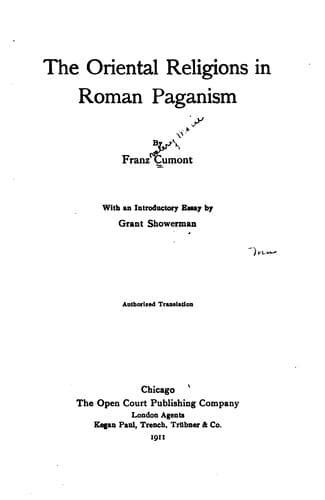
The Oriental Religions in Roman PaganismCumont, Franz
Religion
The Oriental Religions in Roman Paganism
Cumont, Franz
Paganism -- Rome; Religions; Rome -- Religion
[Greek: Chaldaioi ton allon anthropon ekpeponekenai kai diapherontos
dokousin astronomian kai genethlialogiken, ta epigeia tois meteorois kai ta
ourania tois epi ges harmozomenoi kai hosper dia mousikes logon ten
emmelestaten sumphonian tou pantos epideiknumenoi tei ton meron pros allela
koinoniai kai sumpatheiai, topois men diezeugmenon, sungeneiai de ou
dioikismenon.]
27. Riess in Pauly-Wissowa, _Realenc._, s. v. "Aberglaube," I, col. 38 f.
28. (_No note with this number in original book--Transcriber._).
29. _Cat._, V, 1, p. 210, where a number of other examples will be found.
30. See Boll, _Sphaera_ (_passim_), and his note on the lists of animals
assigned to the planets, in Roscher, _Lexikon Myth._, s. v. "Planeten,"
III, col. 2534; cf. _Die Erforsch. der Astrologie_, p. 110, n. 3.
31. _Cat._, V, 1, pp. 210 ff.
32. Cf. _supra_, ch. V. pp. 128 ff.
33. Cf. _supra_, ch. V, n. 87.
34. On worship of the sky, of the signs of the zodiac, and of the elements,
cf. _Mon. myst. Mithra_, I, pp. 85 ff., 98 ff., 108 ff.
35. The magico-religious notion of sanctity, of _mana_, appeared in the
idea and notation of time. This has been shown by Hubert in his profound
analysis of _La representation du temps dans la religion et la magie_
(_Progr. ec. des Hautes-Etudes_), 1905 = _Melanges hist. des rel._, Paris,
1909, p. 190.
36. On the worship of Time see _Mon. myst. Mithra_, I, pp. 20, {274} 74
ff.; of the seasons: _ibid._, pp. 92 ff. There is no doubt that the
veneration of time and its subdivisions (seasons, months, days, etc.)
spread through the influence of astrology. Zeno had deified them; see
Cicero, _Nat. D._, II, 63 (= von Arnim, fr. 165): "Astris hod idem (i. e.
vim divinam) tribuit, tum annis, mensibus, annorumque mutationibus." In
conformity with the materialism of the Stoics these subdivisions of time
were conceived by him as bodies (von Arnim, _loc. cit._, II, fr. 665; cf.
Zeller, _Ph. Gr._, IV, p. 316, p. 221). The later texts have been collected
by Drexler in Roscher, _Lexikon_, s. v. "Men," II, col. 2689. See also
Ambrosiaster, _Comm. in epist. Galat._, IV, 10 (Migne, col. 381 B). Egypt
had worshiped the hours, the months, and the propitious and adverse years
as gods long before the Occident; see Wiedemann, _loc. cit._ (_infra_, n.
64) pp. 7 ff.
37. They adorn many astronomical manuscripts, particularly the _Vaticanus
gr._ 1291, the archetype of which dates back to the third century of our
era; cf. Boll, _Sitzungsb. Akad. Muenchen_, 1899, pp. 125 ff., 136 ff.
38. Piper, _Mythologie der christl. Kunst_, 1851, II, pp. 313 f. Cf. _Mon.
myst. Mithra_, I, p. 220.
39. Bidez, _Berose et la grande annee_ in the _Melanges Paul Fredericq_,
Brussels, 1904, pp. 9 ff.
40. Cf. _supra_, pp. 126, 158 f.
Public-domain text, read in full here on John Shaqi.
Reviews
Reviews
No reviews yet
Be the first to share your thoughts on this work.
Elsewhere in the archive
Join the Discussion
Join the discussion
Sign in to leave a comment or review.
Sign InorCreate an account