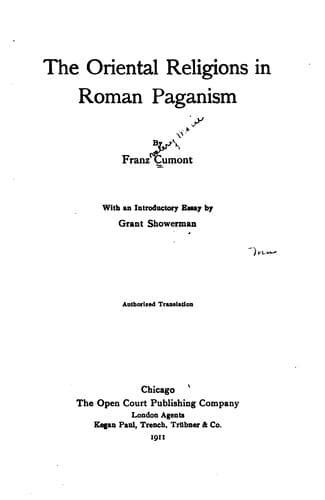
The Oriental Religions in Roman PaganismCumont, Franz
Religion
The Oriental Religions in Roman Paganism
Cumont, Franz
Paganism -- Rome; Religions; Rome -- Religion
41. When Goethe had made the ascent of the Brocken, in 1784, during
splendid weather, he expressed his admiration by writing the following
verses from memory, (II, 115): "Quis caelum possit, nisi caeli munere,
nosse | Et reperire deum, nisi qui pars ipse deorum est?"; cf. _Brief an
Frau von Stein_, No. 518, (Schoell) 1885, quoted by Ellis in _Noctes
Manilianae_, p. viii.
42. This idea in the verse of Manilius (n. 41, cf. IV, 910), and which may
be found earlier in _Somnium Scipionis_ (III, 4; see Macrobius, _Comment._
I, 14, Sec. 16; "Animi societatem cum caelo et sideribus habere communem";
Pseudo-Apul., _Asclepius_, c. 6, c. 9. Firmicus Maternus, _Astrol._, I, 5,
Sec. 10). dates back to Posidonius who made the contemplation of the sky one
of the sources of the belief in God (Capelle, _Jahrb._ {275} _fuer das
klass. Altertum_, VIII, 1905, p. 534, n. 4), and it is even older than
that, for Hipparchus had already admitted a "cognationem cum homine
siderum, animasque, nostras partem esse caeli" (Pliny, _Hist. nat._, II,
26, Sec. 95).
43. Vettius Valens, IX, 8 (_Cat. codd. astr._, V, 2, p. 123 = p. 346, 20,
Kroll ed.), VI, prooem. (_Cat._, ibid. p. 34, p. 35, 14 = p. 242, 16, 29,
Kroll ed.); cf. the passages of Philo collected by Cohn, _De opificio
mundi_, c. 23, p. 24, and Capelle, _loc. cit._
44. Manilius, IV, 14.
45. Cf. my article on _L'eternite des empereurs_ (_Rev. hist. litt.
relig._, I), 1898, pp. 445 ff.
46. Reitzenstein, to whom belongs the credit of having shown the strength
of this astrological fatalism (see _infra_, n. 57), believes that it
developed in Egypt, but surely he is wrong. In this connection see the
observations of Bousset, _Goetting. gel. Anzeigen_, 1905, p. 704.
47. The most important work is unfortunately lost: it was the [Greek: Peri
heimarmenes] by Diodorus of Tarsus. Photius has left us a summary (_cod._
223). We possess a treatise on the same subject by Gregory of Nyssa (_P.
G._, XLV, p. 145). They were supported by the Platonist Hierocles (Photius,
_cod._ 214, p. 172 b.).--Many attacks on astrology are found in St.
Ephraim, _Opera syriaca_, II, pp. 437 ff.; St. Basil (_Hexaem._, VI, 5),
St. Gregory of Nazianzen, St. Methodus (_Symp., P. G._, XVII, p. 1173);
later in St. John Chrysostom, Procopus of Gaza, etc. A curious extract from
Julian of Halicarnassus has been published by Usener, _Rheinisches Mus._,
LV, 1900, p. 321.--We have spoken briefly of the Latin polemics in the
_Revue d'hist. et de litt. relig._, VIII, 1903, pp. 423 f. A work entitled
De Fato (Bardenhewer, _Gesch. altchr. Lit._, I, p. 315) has been attributed
to Minucius Felix; Nicetas of Remesiana (about 400) wrote a book _Adversus
genethlialogiam_ (Gennadius, _Vir. inl._, c. 22), but the principal
adversary of the _mathematici_ was St. Augustine (_Civ. Dei_, c. 1 ff.;
_Epist._, 246, ad Lampadium, etc.). See also Wendland, _Die
hellenistisch-roemische Kultur_, p. 172, n. 2.
Public-domain text, read in full here on John Shaqi.
Reviews
Reviews
No reviews yet
Be the first to share your thoughts on this work.
Elsewhere in the archive
Join the Discussion
Join the discussion
Sign in to leave a comment or review.
Sign InorCreate an account