The Oriental Religions in Roman Paganism — John Shaqi
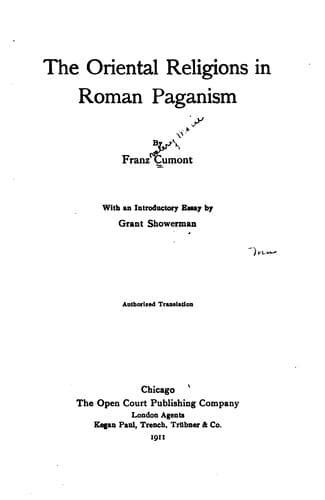
The Oriental Religions in Roman PaganismCumont, Franz
Religion
The Oriental Religions in Roman Paganism
Cumont, Franz
Paganism -- Rome; Religions; Rome -- Religion
An example will make my meaning clear. A Celtic divinity, Epona,[5] was
held in particular honor as the protectress of horses, as we all know. The
Gallic horsemen worshiped her wherever they were cantoned; her monuments
have been found scattered from Scotland to Transylvania. And yet, although
this goddess enjoyed the same conditions as, for instance Jupiter
_Dolichenus_ whom the cohorts of Commagene introduced into Europe, it does
not appear that she ever received the homage of many strangers; it does not
appear, above all, that druidism ever assumed the shape of "mysteries of
Epona" into which Greeks and Romans would have asked to be initiated. It
was too deficient in the intrinsic strength of the Oriental religions, to
make proselytes.
Other historians and thinkers of to-day prefer to apply the laws of natural
science to religious phenomena; and the theories about the variation of
species find an unforeseen application here. It is maintained that the
immigration of Orientals, of Syrians in particular, was considerable enough
to provoke an alteration and rapid deterioration in the robust Italic and
Celtic races. In addition, a social status contrary to nature, and a bad
political regime effected the destruction of the strongest, the
extermination of the best and the ascendancy of the worst elements of the
population. This multitude, corrupted by deleterious cross-breeding and
weakened by bad selection, became unable to {26} oppose the invasion of the
Asiatic chimeras and aberrations. A lowering of the intellectual level and
the disappearance of the critical spirit accompanied the decline of morals
and the weakening of character. In the evolution of beliefs the triumph of
the Orient denoted a regression toward barbarism, a return to the remote
origins of faith and to the worship of natural forces. This is a brief
outline of explanations recently proposed and received with some favor.[6]
Public-domain text, read in full here on John Shaqi.
Reviews
Reviews
No reviews yet
Be the first to share your thoughts on this work.
Join the Discussion
Join the discussion
Sign in to leave a comment or review.
Sign InorCreate an account