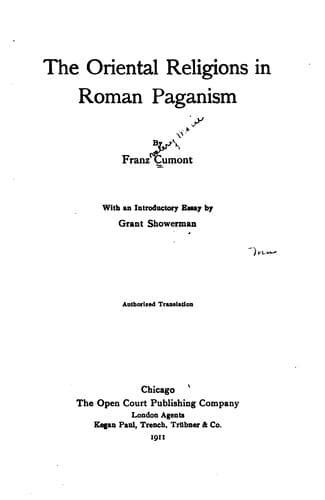
The Oriental Religions in Roman PaganismCumont, Franz
Religion
The Oriental Religions in Roman Paganism
Cumont, Franz
Paganism -- Rome; Religions; Rome -- Religion
If it is true that every conversion involves a psychological crisis, a
transformation of the intimate personality of the individual, this is
especially true of the propagation of the Oriental religions. Born outside
of the narrow limits of the Roman city, they grew up frequently in
hostility to it, and were international, consequently individual. The bond
that formerly kept devotion centered upon the city or the tribe, upon the
_gens_ or the family, was broken. In place of the ancient social groups
communities of initiates came into existence, who considered themselves
brothers no matter where they came from.[8] A god, conceived of as being
universal, received every mortal as his child. Whenever these religions had
any relation to the state they were no longer called upon to support old
municipal or social institutions, but to lend their strength to the {28}
authority of a sovereign regarded as the eternal lord of the whole world
jointly with God himself. In the circles of the mystics, Asiatics mingled
with Romans, and slaves with high functionaries. The adoption of the same
faith made the poor freedman the equal and sometimes the superior, of the
decurion and the _clarissimus_. All submitted to the same rules and
participated in the same festivities, in which the distinctions of an
aristocratic society and the differences of blood and country were
obliterated. The distinctions of race and nationality, of magistrate and
father of a family, of patrician and plebeian, of citizen and foreigner,
were abolished; all were but men, and in order to recruit members, those
religions worked upon man and his character.
In order to gain the masses and the cream of Roman society (as they did for
a whole century) the barbarian mysteries had to possess a powerful charm,
they had to satisfy the deep wants of the human soul, and their strength
had to be superior to that of the ancient Greco-Roman religion. To explain
the reasons for their victory we must try to reveal the nature of this
superiority--I mean their superiority in the struggle, without assuming
innate superiority.
I believe that we can define it by stating that those religions gave
greater satisfaction first, to the senses and passions, secondly, to the
intelligence, finally, and above all, to the conscience.
Public-domain text, read in full here on John Shaqi.
Reviews
Reviews
No reviews yet
Be the first to share your thoughts on this work.
Join the Discussion
Join the discussion
Sign in to leave a comment or review.
Sign InorCreate an account