The Oriental Religions in Roman Paganism — John Shaqi
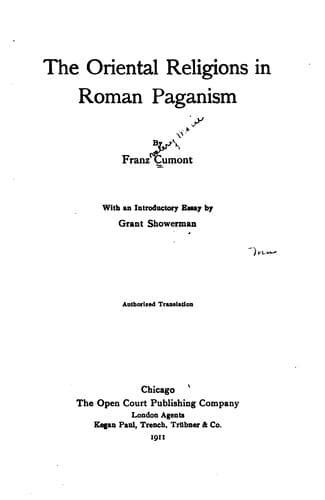
The Oriental Religions in Roman PaganismCumont, Franz
Religion
The Oriental Religions in Roman Paganism
Cumont, Franz
Paganism -- Rome; Religions; Rome -- Religion
Even the gods, with whom the believers thought they were uniting themselves
in their mystic outbursts, were more human and sometimes more sensual than
those of the Occident. The latter had that quietude of soul in which the
philosophic morality of the Greeks saw a privilege of the sage; in the
serenity of Olympus they enjoyed perpetual youth; they were Immortals. The
divinities of the Orient, on the contrary, suffered and died, but only to
revive again.[12] Osiris, Attis and Adonis were mourned like mortals by
wife or mistress, Isis, Cybele or Astarte. With them the mystics moaned for
their deceased god and later, after he had revived, celebrated with
exultation his birth to a new life. Or else they joined in the passion of
Mithra, condemned to create the world in suffering. This common grief and
joy were often expressed with savage violence, by bloody mutilations, long
wails of despair, and extravagant acclamations. The manifestations of the
extreme fanaticism of those barbarian races that had not been touched by
Greek skepticism and the very ardor of their faith inflamed the souls of
the multitudes attracted by the exotic gods.
The Oriental religions touched every chord of sensibility and satisfied the
thirst for religious emotion that the austere Roman creed had been unable
to quench. {31} But at the same time they satisfied the intellect more
fully, and this is my second point.
In very early times Greece--later imitated by Rome--became resolutely
rationalistic: her greatest originality lies here. Her philosophy was
purely laical; thought was unrestrained by any sacred tradition; it even
pretended to pass judgment upon these traditions and condemned or approved
of them. Being sometimes hostile, sometimes indifferent and some times
conciliatory, it always remained independent of faith. But while Greece
thus freed herself from the fetters of a superannuated mythology, and
openly and boldly constructed those systems of metaphysics by means of
which she claimed to solve the enigmas of the universe, her religion lost
its vitality and dried up because it lacked the strengthening nourishment
of reflection. It became a thing devoid of sense, whose _raison d'etre_ was
no longer understood; it embodied dead ideas and an obsolete conception of
the world. In Greece as well as at Rome it was reduced to a collection of
unintelligible rites, scrupulously and mechanically reproduced without
addition or omission because they had been practised by the ancestors of
long ago, and formulas hallowed by the _mos maiorum_, that were no longer
understood or sincerely cherished. Never did a people of advanced culture
have a more infantile religion.
Public-domain text, read in full here on John Shaqi.
Reviews
Reviews
No reviews yet
Be the first to share your thoughts on this work.
Join the Discussion
Join the discussion
Sign in to leave a comment or review.
Sign InorCreate an account