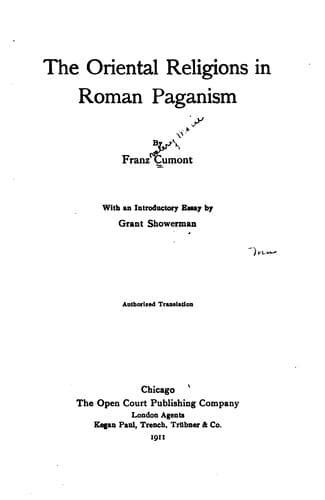
The Oriental Religions in Roman PaganismCumont, Franz
Religion
The Oriental Religions in Roman Paganism
Cumont, Franz
Paganism -- Rome; Religions; Rome -- Religion
And yet, admirable as is M. Cumont's presentation in _The Mysteries of
Mithra_ and _The Oriental Religions_, nothing is a greater mistake than to
suppose that his popularizations are facile reading. The few specialists in
ancient religions may indeed sail smoothly in the current of his thought;
but the very nature of a subject which ramifies so extensively and so
intricately into the whole of ancient life, concerning itself with
practically all the manifestations of ancient {vii}
civilization--philosophy, religion, astrology, magic, mythology,
literature, art, war, commerce, government--will of necessity afford some
obstacle to readers unfamiliar with the study of religion.
It is in the hope of lessening somewhat this natural difficulty of
assimilating M. Cumont's contribution to knowledge, and above all, to life,
that these brief words of introduction are undertaken. The presentation in
outline of the main lines of thought which underlie his conception of the
importance of the Oriental religions in universal history may afford the
uninitiated reader a background against which the author's depiction of the
various cults of the Oriental group will be more easily and clearly seen.
M. Cumont's work, then, transports us in imagination to a time when
Christianity was still--at least in the eyes of Roman pagans--only one of a
numerous array of foreign Eastern religions struggling for recognition in
the Roman world, and especially in the city of Rome. To understand the
conditions under which the new faith finally triumphed, we should first
realize the number of these religions, and the apparently chaotic condition
of paganism when viewed as a system.
"Let us suppose," says M. Cumont, "that in modern Europe the faithful had
deserted the Christian churches to worship Allah or Brahma, to follow the
precepts of Confucius or Buddha, or to adopt the maxims of the Shinto; let
us imagine a great confusion of all the races of the world in which Arabian
mullahs, Chinese scholars, Japanese bonzes, Tibetan lamas and Hindu pundits
should all be preaching fatalism and {viii} predestination,
ancestor-worship and devotion to a deified sovereign, pessimism and
deliverance through annihilation--a confusion in which all those priests
should erect temples of exotic architecture in our cities and celebrate
their disparate rites therein. Such a dream, which the future may perhaps
realize, would offer a pretty accurate picture of the religious chaos in
which the ancient world was struggling before the reign of Constantine."
Public-domain text, read in full here on John Shaqi.
Reviews
Reviews
No reviews yet
Be the first to share your thoughts on this work.
Join the Discussion
Join the discussion
Sign in to leave a comment or review.
Sign InorCreate an account