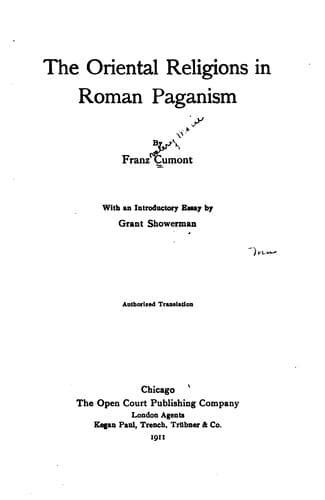
The Oriental Religions in Roman PaganismCumont, Franz
Religion
The Oriental Religions in Roman Paganism
Cumont, Franz
Paganism -- Rome; Religions; Rome -- Religion
It must be admitted, however, that, owing to its extreme flexibility, this
religion was easily adapted to the various centers to which it was
transferred, and that it enjoyed the valuable advantage of being always in
perfect harmony with the prevailing philosophy. Moreover, the syncretic
tendencies of Egypt responded admirably to those that began to obtain at
Rome. At a very early period henotheistic theories had been favorably
received in sacerdotal circles, and while crediting the god of their own
temple with supremacy, the priests admitted that he might have a number of
different personalities, under which he was worshiped simultaneously. In
this way the unity of the supreme being was affirmed for the thinkers, and
polytheism with its {89} intangible traditions maintained for the masses.
In the same manner Isis and Osiris had absorbed several local divinities
under the Pharaohs, and had assumed a complex character that was capable of
indefinite extension. The same process continued under the Ptolemies when
the religion of Egypt came into contact with Greece. Isis was identified
simultaneously with Demeter, Aphrodite, Hera, Semele, Io, Tyche, and
others. She was considered the queen of heaven and hell, of earth and sea.
She was "the past, the present and the future,"[42] "nature the mother of
things, the mistress of the elements, born at the beginning of the
centuries."[43] She had numberless names, an infinity of different aspects
and an inexhaustible treasure of virtues. In short, she became a
pantheistic power that was everything in one, _una quae est omnia_.[44]
The authority of Serapis was no less exalted, and his field no less
extensive. He also was regarded as a universal god of whom men liked to say
that he was "unique." ([Greek: Heis Zeus Sarapis]) In him all energies were
centered, although the functions of Zeus, of Pluto or of Helios were
especially ascribed to him. For many centuries Osiris had been worshiped at
Abydos both as author of fecundity and lord of the underworld,[45] and this
double character early caused him to be identified with the sun, which
fertilizes the earth during its diurnal course and travels through the
subterranean realms at night. Thus the conception of this nature divinity,
that had already prevailed along the Nile, accorded without difficulty with
the solar pantheism that was the last form of Roman paganism. This
theological system, which did not gain the upper hand in the Occident until
the {90} second century of our era, was not brought in by Egypt. It did not
have the exclusive predominance there that it had held under the empire,
and even in Plutarch's time it was only one creed among many.[46] The
deciding influence in this matter was exercised by the Syrian Baals and the
Chaldean astrology.
Public-domain text, read in full here on John Shaqi.
Reviews
Reviews
No reviews yet
Be the first to share your thoughts on this work.
Elsewhere in the archive
Join the Discussion
Join the discussion
Sign in to leave a comment or review.
Sign InorCreate an account