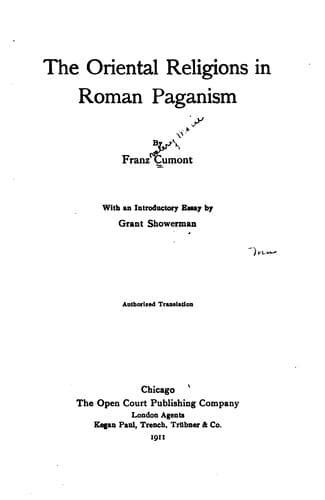
The Oriental Religions in Roman PaganismCumont, Franz
Religion
The Oriental Religions in Roman Paganism
Cumont, Franz
Paganism -- Rome; Religions; Rome -- Religion
The theology of the Egyptian mysteries, then, followed rather than led the
general influx of ideas. The same may be said of their ethics. It did not
force itself upon the world by lofty moral precepts, nor by a sublime ideal
of holiness. Many have admired the edifying list in the Book of the Dead,
that rightfully or otherwise sets forth the virtues which the deceased
claims to have practised in order to obtain a favorable judgment from
Osiris. If one considers the period in which it appears, this ethics is
undoubtedly very elevated, but it seems rudimentary and even childish if
one compares it with the principles formulated by the Roman jurists, to say
nothing of the minute psychological analyses of the Stoic casuists. In this
range of ideas also, the maintenance of the most striking contrasts
characterizes Egyptian mentality, which was never shocked by the cruelties
and obscenities that sullied the mythology and the ritual. Like Epicurus at
Athens, some of the sacred texts actually invited the believers to enjoy
life before the sadness of death.[47]
Isis was not a very austere goddess at the time she entered Italy.
Identified with Venus, as Harpocrates was with Eros, she was honored
especially by the women with whom love was a profession. In Alexandria, the
city of pleasure, she had lost all severity, and at Rome this good goddess
remained very indulgent to human weaknesses. Juvenal harshly refers to {91}
her as a procuress,[48] and her temples had a more than doubtful
reputation, for they were frequented by young men in quest of gallant
adventures. Apuleius himself chose a lewd tale in which to display his
fervor as an initiate.
But we have said that Egypt was full of contradictions, and when a more
exacting morality demanded that the gods should make man virtuous, the
Alexandrian mysteries offered to satisfy that demand.
At all times the Egyptian ritual attributed considerable importance to
purity, or, to use a more adequate term, to cleanliness. Before every
ceremony the officiating priest had to submit to ablutions, sometimes to
fumigations or anointing, and to abstain from certain foods and from
incontinence for a certain time. Originally no moral idea was connected
with this purification. It was considered a means of exorcising malevolent
demons or of putting the priest into a state in which the sacrifice
performed by him could have the expected effect. It was similar to the
diet, shower-baths and massage prescribed by physicians for physical
health. The internal status of the officiating person was a matter of as
much indifference to the celestial spirits as the actual worth of the
deceased was to Osiris, the judge of the underworld. All that was necessary
to have him open the fields of Aalu to the soul was to pronounce the
liturgic formulas, and if the soul declared its innocence in the prescribed
terms its word was readily accepted.
Public-domain text, read in full here on John Shaqi.
Reviews
Reviews
No reviews yet
Be the first to share your thoughts on this work.
Elsewhere in the archive
Join the Discussion
Join the discussion
Sign in to leave a comment or review.
Sign InorCreate an account