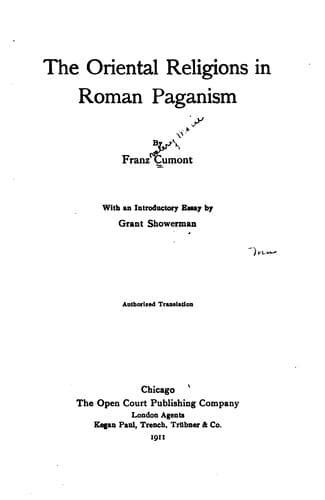
The Oriental Religions in Roman PaganismCumont, Franz
Religion
The Oriental Religions in Roman Paganism
Cumont, Franz
Paganism -- Rome; Religions; Rome -- Religion
It is possible that all this might disquiet the minds of those who have
been wont to assume perfection in the primitive Christian church, and who
assume also that present-day Christianity is the ultimate form of the
Christian religion. Such persons--if there are {xiv} such--should rather
take heart from the whole-souled devotion to truth everywhere to be seen in
the works of scholars in ancient religion, and from their equally evident
sympathy with all manifestations of human effort to establish the divine
relation; but most of all from their universal testimony that for all time
and in all places and under all conditions the human heart has felt
powerfully the need of the divine relation. From the knowledge that the
desire to get right with God--the common and essential element in all
religions--has been the most universal and the most potent and persistent
factor in past history, it is not far to the conviction that it will always
continue to be so, and that the struggle toward the divine light of
religion pure and undefiled will never perish from the earth.
GRANT SHOWERMAN.
THE UNIVERSITY OF WISCONSIN.
* * * * *
Notes to Introduction.
[1] This summary of M. Cumont's chapter is quoted from my review of the
first edition of _Les religions orientales_ in _Classical Philology_, III,
4, p. 467.
[2] _Die Religion der Roemer_, p. 116. For the significance of the pagan
faiths, see an essay on "The Ancient Religions in Universal History,"
_American Journal of Philology_, XXIX, 2. pp. 156-171.
* * * * *
{xv}
PREFACE.
In November, 1905, the College de France honored the writer by asking him
to succeed M. Naville in opening the series of lectures instituted by the
Michonis foundation. A few months later the "Hibbert Trust" invited him to
Oxford to develop certain subjects which he had touched upon at Paris. In
this volume have been collected the contents of both series with the
addition of a short bibliography and notes intended for scholars desirous
of verifying assertions made in the text.[1] The form of the work has
scarcely been changed, but we trust that these pages, intended though they
were for oral delivery, will bear reading, and that the title of these
studies will not seem too ambitious for what they have to offer. The
propagation of the Oriental religions, with the development of
neo-Platonism, is the leading fact in the moral history of the pagan
empire. May this small volume on a great subject throw at least some light
upon this truth, and may the reader receive these essays with the same kind
interest shown by the audiences at Paris and Oxford.
Public-domain text, read in full here on John Shaqi.
Reviews
Reviews
No reviews yet
Be the first to share your thoughts on this work.
Join the Discussion
Join the discussion
Sign in to leave a comment or review.
Sign InorCreate an account