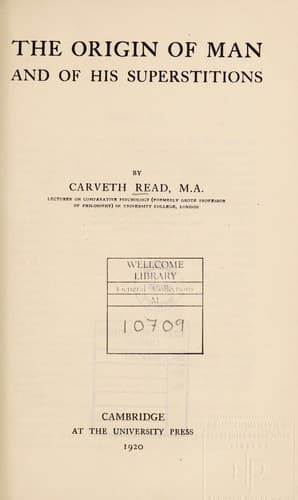
The Origin of Man and of His SuperstitionsRead, Carveth
Philosophy
The Origin of Man and of His Superstitions
Read, Carveth
Animism; Human beings -- Origin; Magic; Superstition; Totemism
And if it once has been, it always will be: not that he thinks of
it in this general way. But even animals, as soon as they have
learnt a sequence, trust to it. Dogs and cats learn faster than
guinea-pigs; monkeys faster than dogs and cats; man quicker still.
But in no case would there be any use in learning, if it did not
lead to action as if the experience had been generalised. There is
no mystery in generalisation; it is spontaneous, and only waits for
language to express itself; the difficult thing to acquire is caution.
In default of method, the only test of truth is relative constancy
in experience—_per enumerationem simplicem_—faulty but broadly
effective; which requires time and practice. Primitive Magic is an
incautious, unexpressed generalisation; and the conditions are such
that the error cannot be easily detected. As long as a savage follows
the instinctive, traditionary and acquired knowledge that he has of
hunting, practices based on wrong judgments, but not interfering with
the traditionary art, such as the carrying about of a bone, or a
crystal, or having a special pattern on his quiver, cannot impair his
success; may add to it by increasing his confidence: so that as long as
success lasts there is nothing to suggest the falsity of the judgment.
A series of failures may make the hunter throw away his talisman, or
(at a later stage of Magic) take it to a medicine-man to be redoctored.
How many thousands of times may Magic have begun in this way and lost
its hold again, before the human mind became chronically infected with
it!
Similarly with amulets, anything unusual that a man happens to have
about him, when attacked by a leopard or snake, from which he escapes,
may be kept as a safeguard against future perils. And with rites:
any gesture or action, however irrelevant, that happens to precede
a successful effort, may be repeated in order to reinstate all the
antecedents of success. So, too, with the origin of spells. It is a
common impulse, and quite spontaneous, to accompany an action with
words, incentive or expletive. If a hunter does so in driving home
his spear successfully, he will next time repeat the words: they then
become a spell.[106] First, then, there are practices of carrying
about charms, repeating words, repeating actions; next, along with
these practices, beliefs grow up as to the nature of their efficacy,
their virtue; and much later it is discovered that some of the
practices seem to involve certain common principles which the savage
had never thought of.
Public-domain text, read in full here on John Shaqi.
Reviews
Reviews
No reviews yet
Be the first to share your thoughts on this work.
Elsewhere in the archive
Join the Discussion
Join the discussion
Sign in to leave a comment or review.
Sign InorCreate an account