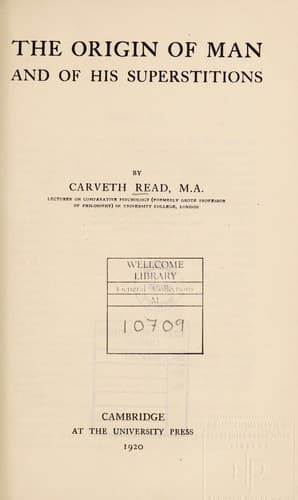
The Origin of Man and of His SuperstitionsRead, Carveth
Philosophy
The Origin of Man and of His Superstitions
Read, Carveth
Animism; Human beings -- Origin; Magic; Superstition; Totemism
In trying to imagine ourselves in the place of such a man, we must not
omit the emotional excitement that determines his judgment. It is the
intensity of his desire for success, his anxiety about it, that makes
him snatch at, and cling to, whatever may possibly be a means to it: he
does not see how it acts, but will take no risks by omitting it. Since
what is true of primitive hunting is true of all undertakings—that
we know some conditions of success but far from all—and since we are
all of us frequently in this position—the wonder is that we resort so
little to Magic. That many people do so in London is notorious.
§ 4. MAGICAL FORCE AND PRIMITIVE IDEAS OF CAUSATION
Magic is a uniform connexion of events, depending on some impersonal
force that has no real existence. What causes make men believe in such
force? In the first place, everything is necessarily conceived of by
everybody (and probably in some dim way by the higher animals) as a
centre of forces. Its weight, when we try to lift it; inertia, when
we push it, or when it is moving and we try to stop it; degree of
hardness, when we strike or grasp it; elasticity, when the bent bough
of a tree recoils; the sway of torrents and the lift of waves; falling
trees, avalanches, water-spouts, hurricanes: all these things a man
must think of, as he does of other men and animals, in comparison with
his own strength or impotence. Into their actions and reactions he
reads such tension and effort as he himself feels in struggling with
them, or in grappling one of his own hands with the other; and as
their action is full of surprises he does not suppose himself to know
all that they can do.
But, further, the strain exhibited by some objects, especially trees;
the noises they make, creaking and groaning in the wind; the shrieking
and moaning of the wind itself, the threatening and whispering of the
sea, thunder and the roar of torrents: all excite _Einfühlung_ or
empathy, illusory sympathy with things that do not feel. Their voices,
more than anything else, I believe, endow them for our imaginations
with an inward life, which Mr. Marett has well called Animatism,[107]
and which must not be confounded with the Animism that used to be
attributed to all children and all savages—the belief that every
object is actuated by a spirit, or even that it has a consciousness
like our own. What truth there was in that doctrine is fully covered by
Animatism.
Again, the savage is acquainted with invisible forces some of which
seem to act at a distance. The wind is the great type of invisible
force; heat, sound, odour are also invisible, and act at a distance;
the light of the camp-fire acts at a distance, spreading across the
prairie or into the recesses of the forest; and lightnings issue from
the clouds. In dreams, one visits some remote hunting-ground and
returns instantly; distance and time are distorted or annihilated; and
if you can act where you dream, why not where you intensely imagine
yourself?
Public-domain text, read in full here on John Shaqi.
Reviews
Reviews
No reviews yet
Be the first to share your thoughts on this work.
Elsewhere in the archive
Join the Discussion
Join the discussion
Sign in to leave a comment or review.
Sign InorCreate an account