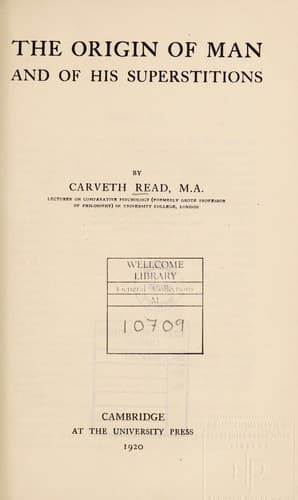
The Origin of Man and of His SuperstitionsRead, Carveth
Philosophy
The Origin of Man and of His Superstitions
Read, Carveth
Animism; Human beings -- Origin; Magic; Superstition; Totemism
Hence there are abundant analogues in experience by which the savage
can conceive of his talisman as a force-thing that acts invisibly and
acts at a distance. Australian medicine-men “threw their joïas (evil
magic) invisibly, ‘like the wind,’ as they said.”[108] The talisman
acts at a distance, like a missile; it acts for the person who owns it
as his spear does, and is dangerous to others who have not practised
with it. Sometimes, indeed, magic things have no owners, and are
dangerous to everybody: malignant influence radiating from them, like
the heat of a fire or the stench of a corpse. Such are two stones
described by Messrs. Spencer and Gillen[109] as marking the place
where an old man and two women died for breaking a marriage-taboo.
“They are so full of evil magic that if any but old men go near, it
kills them. Now and then a very old man goes and throws stones and
bushes upon the spot to keep down the evil magic.” It is as if one
covered up a fire or a corpse. And, further, magical force may exist
in a diffused way, like darkness, heat, cold, epidemic disease, tribal
unrest, without necessarily attaching to any particular thing. In the
Western Isles of Torres Straits[110] mishaps may be signs of an unlucky
state of things in general. A fisherman, usually successful, having
once failed at his task, was depressed; but on two women dying in his
village soon after, he was consoled; since this showed that failure
was not his fault. Currents of this magical force, favourable or
unfavourable to things in general, may be seen in the flow and ebb of
the tide, the waxing and waning of the moon, and in the course of the
seasons. From this way of thinking it is but a step to the conception
of _mana_, as it is called in Melanesia:[111] _orenda_ of the Iroquois,
_manitou_ of the Algonquin, _wakanda_ of the Omaha.[112] It is the
power of the wonderful and mysterious in the world, which becomes
especially manifest in Magic and in the agency of spirits. Similar
notions are found in many regions at various stages of culture, but
nowhere (I believe) at the lowest stages; so that it is unreasonable to
treat it as the first source of ideas of the supernatural. It is too
comprehensive a generalisation to find expression amongst savages. The
Arunta have got as far as the generalisation of evil Magic under the
name of _arungquiltha_.[113] But _mana_ is a generalisation of all the
imaginary forces of superstition, vague and mysterious; as “cause,” in
popular use, is a generalisation of all the supposed “forces” of nature.
Public-domain text, read in full here on John Shaqi.
Reviews
Reviews
No reviews yet
Be the first to share your thoughts on this work.
Elsewhere in the archive
Join the Discussion
Join the discussion
Sign in to leave a comment or review.
Sign InorCreate an account