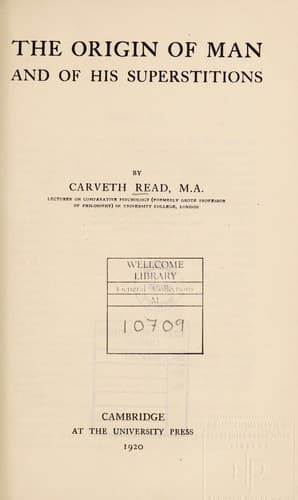
The Origin of Man and of His SuperstitionsRead, Carveth
Philosophy
The Origin of Man and of His Superstitions
Read, Carveth
Animism; Human beings -- Origin; Magic; Superstition; Totemism
If it be asked how this account of the matter can justify the use of
a stick or stone instead of a man’s image, merely assigning it to
represent him, the reply (I think) is that the stick is a symbol. Since
images are never much like the man, and may be unlike in all degrees,
the stick is a sort of limiting case. A symbol is always the remainder,
or reminder, of something that once had intrinsic value, as an image,
shadow, or reflection has by being or participating in the man’s
soul. Besides, it is perhaps a tacit assumption of Magic (as in other
departments of life—including Philosophy), “that whatever for one’s
purpose it is necessary to assume, is real or true”: the situation
demands it.
As to the magical continuity between a man and whatever has been
in contact with him, the belief in it may with some confidence be
derived from the fact that it retains his odour; and when an animistic
explanation is required, it is naturally thought that this odour is his
soul or soul-stuff, as the savour of a burnt-offering is its soul-stuff
that regales the gods.
Belief in the participation of an image, or part or appurtenance of a
man in the man himself, or in his virtue, or in his soul, must give to
rites of black Magic a great deal of the subjective satisfaction which
is a secret motive of all Magic. The images, or nail-parings, or what
not, identify the man to be attacked; they fix the wizard’s attention,
vivify his imagination, direct the spell whom to strike (as a dog is
set upon a trail), and heighten the joy of imaginary revenge.
There are, however, many cases usually classed as “sympathetic
Magic” that cannot without great violence be explained in this way;
and I complain of the epithet “sympathetic,” as applied to all
indirect Magic, that it implies this explanation. Consider the Mandan
buffalo-dances, the hunting dance and the mating dance; these are
imitations or dramatic representations of the hunting of buffaloes and
of their mating, which they are designed to prosper: can such dances
be interpreted as the efflux or decortications of the future hunt or
mating? Or, again, the story of the muræna (quoted above, p. 101)
and its resuscitation by the rising tide—is this a radiation of the
budding of the taro which it is expected to expedite? Such cases, which
are pretty numerous, must be understood upon some other ground than
“participation.”
Public-domain text, read in full here on John Shaqi.
Reviews
Reviews
No reviews yet
Be the first to share your thoughts on this work.
Elsewhere in the archive
Join the Discussion
Join the discussion
Sign in to leave a comment or review.
Sign InorCreate an account