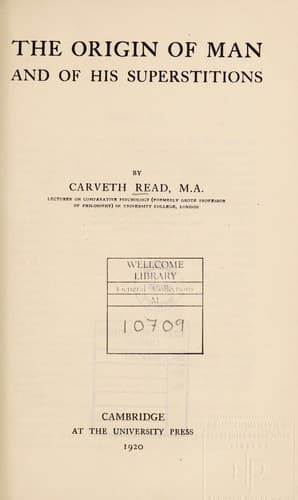
The Origin of Man and of His SuperstitionsRead, Carveth
Philosophy
The Origin of Man and of His Superstitions
Read, Carveth
Animism; Human beings -- Origin; Magic; Superstition; Totemism
(_d_) That whatever is much used in ritual, especially if often
addressed in spells or incantations, should become an object of
reverence, apt to be personified and raised to, or even above, the
human level as a conscious agent: for example, padi and rice in
Indonesia, the ordeal tree on the Congo, already mentioned. Fire-sticks
used in the ritual of sacrifice are often deified. In India, the conch,
having for ages been used in religious rites, “the people gradually
came to revere the instrument itself and to adore and invoke it.”[172]
“A strange religious feature [of the _Rigveda_] pointing to a remote
antiquity is the occasional deification and worship even of objects
fashioned by the hand of man, when regarded as useful to him. These
are chiefly sacrificial implements.”[173] The practice now extends in
India to nearly every tool and utensil. Amongst the very few inanimate
gods of the Cherokees are the Stone, invoked by the Shaman when seeking
lost goods by means of a pebble suspended by a string; and the Flint,
invoked when about to scarify a patient with an arrow-head before
rubbing in medicine.[174] By the Apache, heddontin (pollen of the
cat-tail rush) is used as the sacrificial powder in nearly all rites,
and is personified and prayed to.[175] When spells are addressed to
any object, the analogy of address to human beings tends to cause that
object to be thought of as humanly conscious.
(_e_) Stocks and stones have been worshipped, as the dwelling-place of
spirits in many parts of the world; having superseded in the mind of
their devotees the ghost of the men whose burial-place they formerly
marked, but who themselves have been forgotten; and probably, on the
analogy of these stones, others that no ghost ever haunted.
(_f_) Where Animism is active amongst a timid and suspicious people,
whatever injures a man is believed to act of malice: as amongst the
Indians of Guiana, who are so timid that rather than go hunting alone
they will take a woman or a child along with them.[176]
Under such conditions as these a sort of acquired psychological
Animism is very widely though very irregularly diffused; but were it
universal and uniform, it could not of itself account for hyperphysical
Animism—the doctrine that men (or some men), some animals, plants,
things, places, are possessed or informed by spirits that are capable
of separate existence.
§ 3. THE GHOST THEORY
Public-domain text, read in full here on John Shaqi.
Reviews
Reviews
No reviews yet
Be the first to share your thoughts on this work.
Elsewhere in the archive
Join the Discussion
Join the discussion
Sign in to leave a comment or review.
Sign InorCreate an account