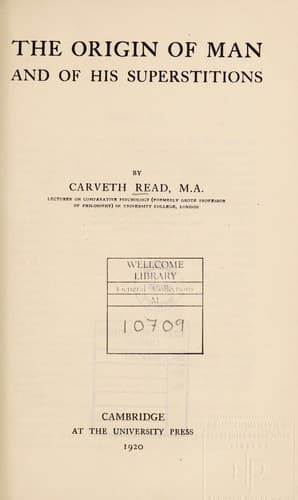
The Origin of Man and of His SuperstitionsRead, Carveth
Philosophy
The Origin of Man and of His Superstitions
Read, Carveth
Animism; Human beings -- Origin; Magic; Superstition; Totemism
Hyperphysical Animism may be easiest understood as having arisen with
the belief in human ghosts. The causes of this belief have been fully
set forth by Herbert Spencer[177] and Sir E. B. Tylor[178] in a way
that to my mind is convincing. Amongst those causes dreams predominate;
wherein the dead are met again as in the flesh. The living body having
always been for the savage a conscious force-thing, at death the
conscious force leaves the thing or corpse. This might be accepted by
him as a fact of the same kind as the loss of its virtue by a talisman
or amulet (which is known sometimes to happen), were it not for dreams
in which the dead still live. That this conscious force that has left
the body is not visible except in dreams need excite little wonder,
since many forces natural and magical are invisible.
A dream not being common to two men at the same time, the things that
are seen in it cannot be pointed out, nor therefore directly named (in
this resembling subjective experiences). It was for ages impossible to
narrate a dream as a dream: there was no way of distinguishing it from
external events, either for the dreamer himself or (were that possible)
in reporting it to another. He was far away and met his father, yet had
lain by the fire all night! Hence to find names with which to describe
such things men turned to other ways in which they seemed to have a
double existence, to shadows and reflections: which in their sudden
appearance and disappearance, and sometimes faint, sometimes distorted
outlines, bear some resemblance to dream-images; and probably it is
felt to be significant that shadows and reflections disappear at night,
just when dreams occur. Shadows and reflections are not necessarily
identified with the ghost derived from the dream-image, because their
names are given to it; but sometimes they certainly are; so that a
man who, on looking into water, happens not to see his reflection may
believe that his spirit has gone away, and that he himself must be
ill, and accordingly he becomes ill; or if at noon near the equator he
notices that he has no shadow, he may think his soul is gone, and run
to a medicine-man to get it back; and dead bodies may be believed to
have no shadows.[179] Inasmuch as a body even lying on the ground casts
a shadow, except at tropical noon, the belief that it does not do so
at any time implies an acquired inability to see what is before one’s
eyes; as sometimes happens in hypnosis and other conditions of negative
hallucination.
Public-domain text, read in full here on John Shaqi.
Reviews
Reviews
No reviews yet
Be the first to share your thoughts on this work.
Elsewhere in the archive
Join the Discussion
Join the discussion
Sign in to leave a comment or review.
Sign InorCreate an account