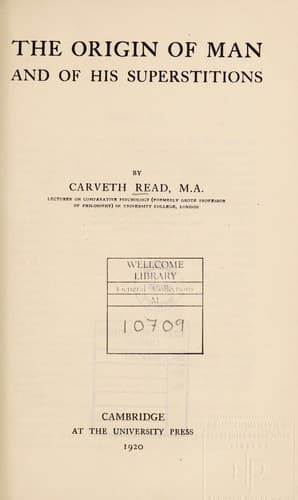
The Origin of Man and of His SuperstitionsRead, Carveth
Philosophy
The Origin of Man and of His Superstitions
Read, Carveth
Animism; Human beings -- Origin; Magic; Superstition; Totemism
Spirits, having once been conceived of as explaining the actions of
men and surviving their bodily death, may by analogy be conceived to
explain the action of any other things in circumstances that suggest
a motive for the action, and therefore to possess or inhabit such
things, and to be capable of separating from them, like ghosts. Other
things are already, by Magic and Animatism, force-things, in some
degree conscious, whose forces may be capable of acting invisibly at
a distance; and at the death of a man it is his conscious force that
leaves the body and becomes a ghost. Since, then, there is hardly any
natural object whose action may not in some circumstances seem to be
interpretable by motives, especially amongst a timid and suspicious
people, how can we assign any necessary limits to the spread of
Animism? Moreover, the causes most influential in establishing the
ghost theory for man directly require its extension to other things.
For not human beings only are seen in dreams, but also their clothes,
weapons and utensils, and also animals, plants, localities. If,
then, the dead, because they are seen in dreams, are inferred still
to live under conditions in which they are not visible by daylight
to ordinary men, how can the inference be avoided that all sorts
of things, artefacts, animals, plants, localities, share in that
mode of existence—that all have their doubles? And “Why not?” the
savage might ask, since it is literally true of all things, without
exception, that they are sometimes visible, sometimes invisible.[188]
Similar inferences seem to be justifiable from the alliance of ghosts
with shadows and reflections, and the fact that not man only but
everything else has a shadow and a reflection, and that their shadows
and reflections disappear at night, just when the things themselves
sometimes appear in dreams. Moreover, so far as the breath, the pulse,
the shining of the eye, which cease in the human corpse, are sometimes
identified with the departed spirit, the same processes likewise cease
at the death of animals; though, it is true, there is here no analogy
with inanimate things, and the breathing and circulation of plants are
beyond the savage’s observation. Therefore, although Animism is an
inferential construction, were the construction entirely due to the
logic of analogy, there would be nothing surprising in the discovery
that the belief “that everything has a ghost” is just as universal and
uniform in the human race as if it had been an innate or primitive
belief. That, on the contrary, Animism prevails very irregularly
amongst the tribes of men; that, in all directions, inferences that
are analogically specious fail to be drawn; that instead of a general
system of Animism every tribe has its own Animism; this is surprising
and needs to be explained. The extension of the theory is easier to
understand than its irregular limitation.
Public-domain text, read in full here on John Shaqi.
Reviews
Reviews
No reviews yet
Be the first to share your thoughts on this work.
Elsewhere in the archive
Join the Discussion
Join the discussion
Sign in to leave a comment or review.
Sign InorCreate an account