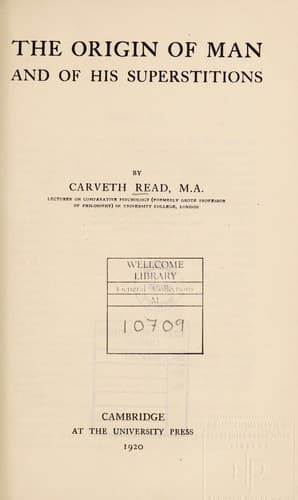
The Origin of Man and of His SuperstitionsRead, Carveth
Philosophy
The Origin of Man and of His Superstitions
Read, Carveth
Animism; Human beings -- Origin; Magic; Superstition; Totemism
It is recognised by psychologists that dreams, as immediate experience,
have more the character of perception than of imagination. Children are
apt to confuse dreams with reality. It can only have been gradually,
with the growing knowledge of continuity and coherence in the course
of events, and therewith the demand for corroboration of testimony,
that dreams were distinguished from the waking life. When no longer
supposed to be all of them real, some are still so regarded: the Dieri,
amongst lower savages, distinguish between visions, as revelations made
by Kutchi (an evil Spirit), and ordinary dreams, as mere fancies.[187]
But so impressive are dreams to many people, in their eagerness to know
more than sense and philosophy can tell them, that they persist in
hoping, and therefore believing, that dreams, if they give no knowledge
of this world, may still be revelations of another, perhaps more
real; or if not revelations, adumbrations by way of allegory, which
some learned or inspired Daniel may interpret; or, at least, omens
of good or evil, which the ancient science of Oneiromancy undertakes
to explain. There is now a new and more promising Oneiromancy that
interprets dreams as indicating not the future, but one’s own past,
chiefly a forgotten past, and teaches to know oneself: more promising;
for what but experience can possibly be the source of dreams—at least,
of dream-elements? Some of the new principles of interpretation,
however, may compare for obscurity with the ancient.
That the dead are seen alive in dreams is, then, for the savage a fact
of observation; and, therefore, the continued existence of the dead
is, for him, not in the first place supernatural; although it may be
called hyperphysical, because it is experienced only in dreams and not
by daylight, and is exempt from ordinary conditions of time and place.
But it gradually becomes supernatural, as the capricious incidents
of dream-life are felt to be “uncanny,” as that which occurs only at
night is involved in the fears of the night, and as a great cloud of
imaginations accumulates about the dead and obscures the simple facts
of dream-perception in which the belief originated. This cloud of
imaginations, by its mysterious character and by various alliances
with Magic, spreads and deepens until it overshadows the whole of
human life; is generally, indeed, dispersed here and there by the
forces of biological necessity, often by subterfuges laughable enough;
which have, however, the merit of saving mankind from destruction: but
sometimes it extinguishes the last ray of common sense, impoverishes
the believer, enfeebles him, fills his days and nights with terror,
gives him over to practices the most cruel or the most disgusting,
leads him to slay his own tribesmen, his own children, his own parents,
and to offer up himself in the sure hope of resurrection.
§ 4. EXTENSION OF THE GHOST THEORY TO ANIMALS
Public-domain text, read in full here on John Shaqi.
Reviews
Reviews
No reviews yet
Be the first to share your thoughts on this work.
Elsewhere in the archive
Join the Discussion
Join the discussion
Sign in to leave a comment or review.
Sign InorCreate an account