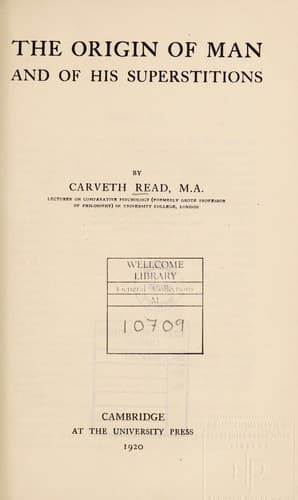
The Origin of Man and of His SuperstitionsRead, Carveth
Philosophy
The Origin of Man and of His Superstitions
Read, Carveth
Animism; Human beings -- Origin; Magic; Superstition; Totemism
Again, in South-East Australia, a _bulk_—a pebble, usually black
and roundish—is carried by wizards as a powerful talisman. A native
dreamt of seeing two ghosts by his camp fire, and, on waking, found
a _bulk_ where they had stood.[280] How could such an impressive
experience fail to raise a belief in a connexion between ghosts and
_bulks_: both so attractive to the imagination, and alike mysterious
and powerful? Many such situations must strongly indicate an extension
of the ghost-theory, once it has been formed, to explain the influence
of charms and rites. A time comes with some tribes when the activity
and ubiquity of spirits is so much a matter of course that every
mysterious power is apt to be ascribed to their presence. If a person
or thing was originally taboo, either by inherent virtue or by force
of a spell or curse—a talisman dangerous to every one who violated
its sanctity—Animism explains the danger by the wrath of a protecting
spirit. A boundary having long been taboo, a spirit is imagined to
protect the boundary, and becomes the god Terminus. Diseases, at first
attributed to Magic, are later explained by Animism; so that whilst an
Australian wizard is content to suck a magically implanted stone or
splinter from his patient’s body, a priest of the Dyaks, having sucked
out a similar object, calls it a spirit.[281] The wonder is that at
this stage of thought any purely magical power can survive.
(_c_) An Omen is regarded as giving warning of some event, although
between event and omen there is no traceable connexion—in this
resembling many magical operations; and at first omens may have
been always so conceived of, and only by degrees distinguished from
charms and spells. But in most parts of the world omens have come to
be treated as divine or spiritual premonitions; and the marks which
distinguish omens from the rest of Magic are such as to favour a growth
of the belief that they are sent by spirits. This subject, however, is
so extensive that a separate chapter must be given to it.
Public-domain text, read in full here on John Shaqi.
Reviews
Reviews
No reviews yet
Be the first to share your thoughts on this work.
Elsewhere in the archive
Join the Discussion
Join the discussion
Sign in to leave a comment or review.
Sign InorCreate an account