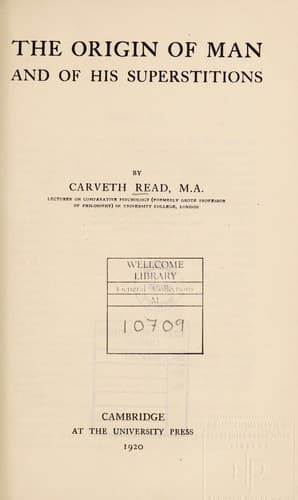
The Origin of Man and of His SuperstitionsRead, Carveth
Philosophy
The Origin of Man and of His Superstitions
Read, Carveth
Animism; Human beings -- Origin; Magic; Superstition; Totemism
(_d_) Inasmuch as spells addressed to any object tend to the
personification of it, the personified object may, as the ghost-theory
gains strength, acquire an indwelling or controlling spirit, and the
spell addressed to it may become a prayer. Not that this is the only
way in which prayer may originate; for (as remarked above) nothing can
be simpler or less in need of explanation than the invoking of the
spirit of one’s relatives (the ghost-theory having been established) to
help one or, at least, not to persecute. Indeed, it is not unreasonable
to suppose that this was often attempted, and not persisted in for
want of obtaining an answer; so that a long tentative age preceded
the settled custom of prayer. Nor is it easy to see how belief in
the efficacy of prayer (beginning in this way) could ever have been
established, unless it were confirmed by coincidence—just like
Magic. However, the earliest form of prayer and of spell (whichever
may have been the earlier) being the same—a simple expression of
desire—whence prayer and spell have been differentiated, it may be
impossible to decide whether a given ejaculation belongs to one class
or to the other. Thus Mr. R. W. Williamson tells us that, amongst the
Mafulu of New Guinea, when fishing in the river Aduala, the fishers,
after forming a weir, but before fixing their net, all join in a sort
of prayer or invocation to the river: “Aduala, give us plenty of
fish that we may eat well.”[282] But he expressly says that, whilst
they believe certain parts of the river, such as a waterfall or deep
pool, to be haunted by spirits, they do not believe this of the river
itself,[283] and that generally their Animism is very backward. The
ejaculation, therefore, seems to be a spell. Compare with it the Jakun
spell to bring monkeys within shooting distance:
“Come ye down with souls enchanted,
Monkeys, by my spells enchanted.”[284]
If, then, the original form of prayer and of spell is often the same,
the sole difference between them lies in the intention of the speaker.
One of the Kurnai, to stop the gales, cried: “Let the West Wind be
bound,”[285] and this is evidently a command and a spell; but if he
regarded the wind as controlled by a spirit, a change of tone would
make it a prayer. Still, whether with the spread of Animism a spell
shall become a prayer, must depend upon whether the spirit addressed is
believed to be the more easily importuned or coerced.
Public-domain text, read in full here on John Shaqi.
Reviews
Reviews
No reviews yet
Be the first to share your thoughts on this work.
Elsewhere in the archive
Join the Discussion
Join the discussion
Sign in to leave a comment or review.
Sign InorCreate an account