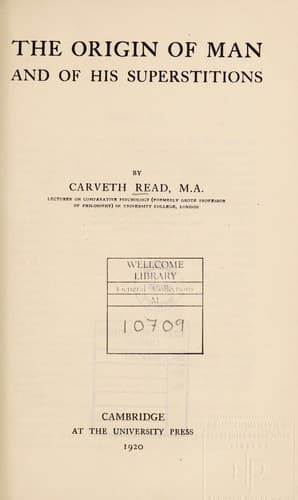
The Origin of Man and of His SuperstitionsRead, Carveth
Philosophy
The Origin of Man and of His Superstitions
Read, Carveth
Animism; Human beings -- Origin; Magic; Superstition; Totemism
The taboo that often attaches to the names of the dead and of other
spirits may easily have been derived from the magical practice of
summoning by name, or of naming the victim of a rite. To call a living
man by name draws his attention and often brings him to the spot; a
magical naming is (from the temper of Magic) uniformly effective; so
that to avoid such control names are kept secret; and when ghosts are
believed in, naming has the same power over them and is, therefore,
extremely dangerous. Hence, in Sorcery (a dangerous art), to introduce
the names of spirits into spells is to secure their presence and
assistance: and, in prayer, to use the true name of the spirit or god
addressed may be indispensable; the worshipper’s intention is not
enough.
(_e_) With the spread of Animism, magical rites often become religious.
This may occur by simply adding the invocation of a spirit to a magical
rite (as a spell may be added) in order to strengthen it—the two
actions remaining quite distinct; or some degree of fusion may take
place, obscuring more or less the original character of the practice.
The Kai (Papuans of northern New Guinea) “make rain” by muttering
a spell over a stone, and at the same time calling upon Balong and
Batu to drive away Yondimi, a woman who holds up the rain; and when
rain enough has fallen, they strew hot ashes on the stone, or put it
in the fire, to stop the rain.[286] The animistic invocation, being
omitted from the process of stopping the rain, seems to be merely
adscititious to the making of it. Again, “When rain is badly wanted
in the Oraon country, the Oraons of each village fix a day for the
rain-making ceremony. On the morning of the appointed day, the women
of the village, with the wife of the village priest or Pahan at
their head, proceed to the village spring or tank, and there, after
ablution, each woman fills her pitcher with water, and all proceed
in a body to a sacred pipar-tree.... On their arrival at the sacred
tree, all the women simultaneously pour the water in their pitchers
over the root of the tree, saying ‘May rain fall on the earth like
this.’ The wife of the village priest now puts marks of vermilion,
diluted in oil, on the trunk of the tree. After this the women depart,
and the Pahan or village priest proceeds to sacrifice a red cock to
the god Baranda at the spot.... In this case, apparently, by direct
alliance, sacrifice and the anointing of the tree with vermilion have
been superimposed upon what was once, perhaps, purely a ceremony of
imitative magic.”[287] Mr. Warde Fowler tells us that an ancient
Iguvian document contains instructions for the lustration of the
people before a campaign: the male population assembled in its military
divisions; around the host a procession went three times; at the end of
each circuit there was prayer to Mars and to two female associates of
his power, to bless the people of Iguvium and to curse their enemies:
Public-domain text, read in full here on John Shaqi.
Reviews
Reviews
No reviews yet
Be the first to share your thoughts on this work.
Elsewhere in the archive
Join the Discussion
Join the discussion
Sign in to leave a comment or review.
Sign InorCreate an account