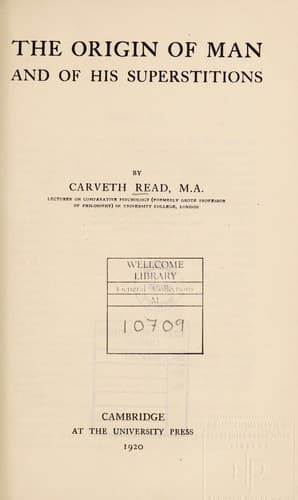
The Origin of Man and of His SuperstitionsRead, Carveth
Philosophy
The Origin of Man and of His Superstitions
Read, Carveth
Animism; Human beings -- Origin; Magic; Superstition; Totemism
(_b_) By Animism, prior to philosophical reflection, the spirit is not
conceived of as strictly incorporeal; its force, which is magical, is
quasi-mechanical. Hence, in South-East Australia, spirits can carry off
a man in a bag[314] (made, no doubt, of bag-soul-stuff). But spirits
may act upon a man very effectually without being mechanically felt;
as among the Ekoi, where ghosts are either good or bad, and generally
a good goes with a bad one to counteract his malevolence; but should a
bad one wander forth alone, and should a man without the gift of seeing
ghosts (which depends upon his having four eyes) run against it in the
street, the ghost will not step aside, but strikes the man in the face;
who then has lock-jaw, and dies.[315] As we have reason to believe that
this is not the natural ætiology of lock-jaw, the ghost’s action is
plainly magical: like that of the corpse-candle which, not long ago, on
a slope of Plinlimmon one rainy night, a man inadvertently ran against,
and was “struck down dead as a horse.”[316] The mere apparition of a
ghost (at least, to any one who has not four eyes) is magical. The
sending of a bird as an omen is magical.
This immediate power of the gods is nowhere shown more emphatically
than in their metamorphoses: that these are sometimes wrought by
spells or other enchantments proves that the operation is magical.
Australian wizards transform themselves into kangaroos and other
animals; and, in Arunta mythology, in the earliest Alcheringa (period
of mythical ancestors), the Ungambikula—so called from having arisen
out of nothing—with stone knives cut men out of rudimentary masses
of unorganised matter (inapertua), and then transformed themselves
into little lizards.[317] So this sort of self-conjuring may be said
to begin at the beginning; and it cannot be necessary to accumulate
examples of metamorphosis.
Public-domain text, read in full here on John Shaqi.
Reviews
Reviews
No reviews yet
Be the first to share your thoughts on this work.
Elsewhere in the archive
Join the Discussion
Join the discussion
Sign in to leave a comment or review.
Sign InorCreate an account