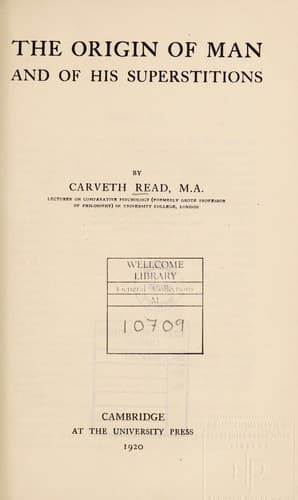
The Origin of Man and of His SuperstitionsRead, Carveth
Philosophy
The Origin of Man and of His Superstitions
Read, Carveth
Animism; Human beings -- Origin; Magic; Superstition; Totemism
Several explanations of this belief in the possibility of changing
the form of one’s body, or of having it changed by others, have been
offered: none perhaps entirely satisfactory. We are not here concerned
with the passing of a soul from one body to another—from a man into
a wolf or into a serpent, or conversely: given the conception of a
separable soul, that is easy to understand. What has to be explained
is the belief in a magical change of the body itself, as in the common
European superstition that a man may turn into a wolf, and back again,
like Sigmund and his son in the _Volsung Saga_. It has been pointed
out (i) that the savage may observe striking changes in nature: as
in the shape of clouds and smoke, the burning of wood into flame,
smoke and ashes, the evaporation of water; the turning of eggs into
caterpillars, reptiles, birds, or of a chrysalis into an imago; the
appearance of worms in putrefying bodies, and so forth.[318] With
such facts before him, why should not the savage imagine himself also
capable of transformation? (ii) Dream-images, too, pass one into
another in a marvellous way. (iii) Since men are often called by the
names of animals, how easy to suppose that, at times, they may really
be those animals. How easy to confound a man with his Totem. In many
savage dances, animals are imitated, and the imagination-belief in
the reality of the pantomime grows very strong. (iv) The savage,
when his imagination has been excited, is not clever at penetrating
conjuring tricks and disguises; and some men, at first for their own
ends, may have disguised themselves as animals and passed as animals;
and in support of this explanation it may be observed that the animal
into which men transform themselves is oftenest the most feared in
their neighbourhood—the wolf, leopard, or tiger; and, of course,
one case believed in, others follow by analogy. The mere report of
such an happening might generate belief by force of fear. (v) In a
wild country, a man (say one who is pursued) often disappears and is
indiscoverable; so that he may seem to have turned into a kangaroo,
or a stone, or a tree that appears in his place, as Daphne hid
successfully in a laurel-thicket: or if such an occurrence did not
originate the belief in metamorphosis, it may have helped to confirm
it. (vi) In mental disease, the patient sometimes believes himself to
be some kind of animal, and acts accordingly: perhaps as a result of
the popular belief, but doubtless also confirming it.[319] Weighing all
these hypotheses, I lean to the view that, starting from the fact (as
ground of analogy) that astonishing changes are observed in nature and
in dreams, the belief in metamorphosis as a magical operation rests
chiefly upon the deceptions and confident assertions of wizards that
they can, and do, change their form, supported by their reputation for
wonder-working and by the fears of their neighbours. Now, if wizards
can change their shapes, of course the gods can.[320]
Public-domain text, read in full here on John Shaqi.
Reviews
Reviews
No reviews yet
Be the first to share your thoughts on this work.
Elsewhere in the archive
Join the Discussion
Join the discussion
Sign in to leave a comment or review.
Sign InorCreate an account