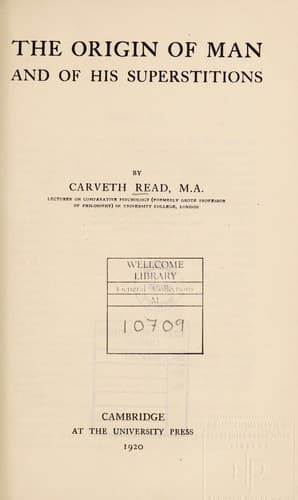
The Origin of Man and of His SuperstitionsRead, Carveth
Philosophy
The Origin of Man and of His Superstitions
Read, Carveth
Animism; Human beings -- Origin; Magic; Superstition; Totemism
The seeking of enlightenment where spirits dwell in caves or graves,
loss of wits by contact with them and subsequent recovery—all this may
remind us of stories in Pausanias; but what of the disembowelling and
renewing of the viscera? We are told by Spencer and Gillen that during
the performance of certain traditionary ceremonies, an Australian’s
emotion is very great, so that he says his inward parts get “tied
up in knots,” and sometimes acquire “sight” and give omens;[375] and
Howitt tells us that fat of the kidneys is believed to be the seat
of a man’s prowess and other virtues.[376] To extract and renew a
man’s entrails, therefore, is to renew his spirit, just as we speak
metaphorically of a “change of heart,” so that he has more vivid
emotions, firmer courage, clearer insight. In fact, it is the magical
equivalent of inspiration; the crystal, too, of the Euahlayi is a magic
source; and this is as far as the Australians have got:[377] gross
materialism, which the progress or (at least) the movement of animistic
thought has happily superseded by conceptions more refined, if not more
truthful.
§ 8. APPARENT FAILURE OF OMENS
Though in their nature infallible, Omens are not always fulfilled—at
least, their fulfilment is not always ascertainable. But this is easily
explained; for whatever an Omen may be in itself, our knowledge of
it depends on observation, which may be superficial and incomplete,
so that we may not know what it was. What kind of bird was it? Which
way did it fly? How many cries did it utter? These questions go to
the heart of the matter; yet each of them points out an opportunity
of error. But granting the observations perfect, we have still to
learn what the Omen portends; and although a simple mind, trusting to
simple rules, may be ready offhand with an answer, it becomes, with the
development of the art of Divination, more and more complicated and
difficult, demanding long experience and profound erudition—something
worth paying for. It is popularly known that dreams are perplexing as
the guide of life. Are they to be accepted at face value, or do they go
by contraries? What difference does it make whether they happen early
in the night, or in the morning, or whether we sleep in white or in
coloured night-clothes? There is an extensive casuistry of this matter.
Interpretations of Omens proceeded generally by analogy: the length
and direction of the cracks in a shoulder-blade indicate the length
and tenor of a man’s life. Oracles, again, were often distractingly
obscure; from Delphi much like riddles; but those of Zeus at Dodona are
said to have been sometimes taken to Apollo at Delphi to ask what they
meant. Clearly, then, besides possible errors of observation, there
were further pitfalls of interpretation; if a physician or a pilot is
sometimes out in his reckoning, why not also a diviner? So that an Omen
might very well be fulfilled without our knowing exactly what it was or
what it indicated.
Public-domain text, read in full here on John Shaqi.
Reviews
Reviews
No reviews yet
Be the first to share your thoughts on this work.
Elsewhere in the archive
Join the Discussion
Join the discussion
Sign in to leave a comment or review.
Sign InorCreate an account