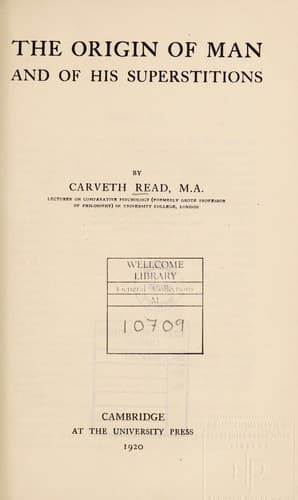
The Origin of Man and of His SuperstitionsRead, Carveth
Philosophy
The Origin of Man and of His Superstitions
Read, Carveth
Animism; Human beings -- Origin; Magic; Superstition; Totemism
The defence of Omens is mere rationalisation. They took possession
of men’s minds not in an age of reason, but when beliefs were freely
born of hope and fear, were entirely practical, were never thought
out and never verified. Whether the connection of Omen with event was
conceived of magically or animistically, it was always mysterious, and
on that account was the more impressive and acceptable. The uniformity
of such connexions was, indeed, assumed—otherwise they were useless;
the same bird’s call on this hand or on that had always the same
significance; but each case at first stood by itself; it was what
we call “a miracle.” Even such assumption of causation in ordinary
cases as common sense implies did not compel the reflection that each
cause must itself be an effect of other causes, and so again, and so
on for ever. Nor did the assumption that spirits could foresee the
future require that they should foresee the whole future, so as to
imply an inviolable order of the world. Such considerations were left
to amuse or perplex a later age. A great advance is marked by the
saying of the Bechuana prince to Casalis, that “one event is the son
of another, and we must never forget the genealogy.”[388] But quite
recently amongst ourselves causation was so feebly appreciated, even by
the most educated, that testimony concerning miracles could still be
appealed to as a ground for believing something further. One reviews
all these wonderful fossils of the soul which are dead and yet alive,
not without sympathy. For myself, I am free to confess, as they used to
say in Parliament, that Omens and presentiments still haunt the shadowy
precincts of imagination with vague shapes and mutterings of evils to
come; which when they approach will be (I suppose) as hard and definite
as daylight.
FOOTNOTES:
[339] VI. c. 27 (Rawlinson’s Translation).
[340] Williams, _Fiji and the Fijians_, p. 152.
[341] De Acosta, _History of the Indies_, VII. c. 23 (translated by
C. R. Markham).
[342] Spencer and Gillen, _Across Australia_, p. 220.
[343] Book I. cc. 7-10.
[344] _Reports of the Cambridge Expedition to Torres Straits_, VI. p.
260.
[345] W. R. Halliday, _Greek Divination_, p. 15.
[346] _Historia Naturalis_, XXVII. p. 4.
[347] Suetonius: _Julius_, c. 59.
[348] Hose and McDougall, _Pagan Tribes of Borneo_, II. pp. 56-64.
[349] _Northern Tribes of Central Australia_, p. 266.
[350] _Reports of the Cambridge Expedition to Torres Straits_, V. p.
361; VI. p. 259.
[351] Seligman, _Mel. of B. N. G._, p. 309.
[352] _De Divinatione_, I. c. 19.
Public-domain text, read in full here on John Shaqi.
Reviews
Reviews
No reviews yet
Be the first to share your thoughts on this work.
Elsewhere in the archive
Join the Discussion
Join the discussion
Sign in to leave a comment or review.
Sign InorCreate an account