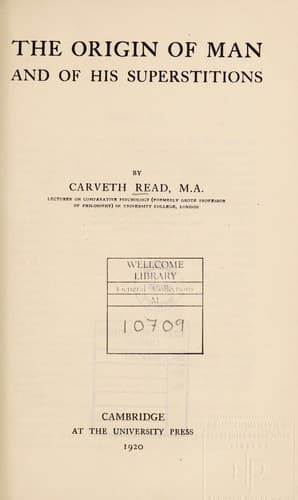
The Origin of Man and of His SuperstitionsRead, Carveth
Philosophy
The Origin of Man and of His Superstitions
Read, Carveth
Animism; Human beings -- Origin; Magic; Superstition; Totemism
[353] An infallible sign is, in Formal Logic, the same as a cause,
according to the scheme _If A, then B_; and it is conceivable that,
with strict thinking, a belief in an Omen may give rise to a magical
practice. “For,” says Lord Avebury, “granted that the fall of a stick
certainly preludes that of the person it represents, it follows that by
upsetting the stick his death can be caused” (_Origin of Civilisation_,
p. 166). I do not see why such an inference should not be drawn, but
can give no example of it. The possibility shows how much community
there is between Magic and the lore of Omens; but as to this particular
case, the magical cast of mind is already implied in the original
setting up of the stick whose fall should prelude that of a given
individual.
[354] Coddrington, _The Melanesians_, p. 123.
[355] A. W. Howitt, _Native Tribes of South-East Australia_, p. 401.
[356] Quoted by Frazer, _Totemism and Exogamy_, I. pp. 489 and 495.
[357] A. W. Howitt, _op. cit._, p. 389.
[358] C. G. Seligman, _op. cit._, p. 188.
[359] VII. c. 16.
[360] The poet is closely allied at first to the wizard; for (besides
that the greatest spells and oracles are versified) the poet is
inspired. In Australia poets are sometimes carried by ghosts into
skyland, where they learn songs and dances. Some compose awake;
but the belief prevails that they are inspired in dreams by dead
and kindred spirits. Their songs travel far amongst tribes that no
longer understand the language. (Howitt, _Native Tribes of South-East
Australia_, pp. 389 and 413.) Similarly in Fiji (_Fiji and the
Fijians_, p. 98). “The poem is too wonderful for me”—such is the
poet’s humility; “it was made by the gods”—such is his arrogance.
[361] Spencer and Gillen, _Native Tribes of Central Australia_, p. 526.
[362] Tylor, _Primitive Culture_, I. p. 125.
[363] Casalis, _Les Bassoutos_, pp. 299 and 340.
[364] Jounod, _Life of a South African Tribe_, I. 361. This “medicine”
is the chief’s great store of magical force: its principal ingredients
are the nails and hair of chiefs deceased, fixed together by a kind of
wax.
[365] Callaway, _Religion of the Amazulu_, p. 417.
[366] W. Ellis, _Polynesian Researches_, II. p. 235.
[367] _De Div._, II. c. 57.
[368] Thomas Williams, _Fiji and the Fijians_, p. 190.
[369] Pausanias, IX. c. 10 (Frazer’s Translation).
[370] Pausanias, I. p. 34.
[371] _Ibid._, IX. p. 30.
[372] Spencer and Gillen, _Native Tribes of Central Australia_, p. 523.
[373] A. W. Howitt, _op. cit._, p. 404.
[374] Langloh Parker, _The Euahlayi_, p. 25.
[375] _Northern Tribes of Central Australia_, p. 181.
[376] _Native Tribes of South-East Australia_, p. 367.
Public-domain text, read in full here on John Shaqi.
Reviews
Reviews
No reviews yet
Be the first to share your thoughts on this work.
Elsewhere in the archive
Join the Discussion
Join the discussion
Sign in to leave a comment or review.
Sign InorCreate an account