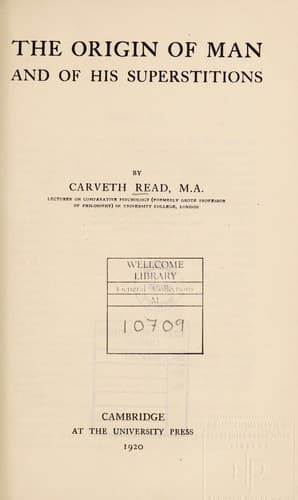
The Origin of Man and of His SuperstitionsRead, Carveth
Philosophy
The Origin of Man and of His Superstitions
Read, Carveth
Animism; Human beings -- Origin; Magic; Superstition; Totemism
Nevertheless in simple societies the wizard is a leader or a chief. The
predominance of old men in council depends upon their occult powers
rather than upon their worldly wisdom: even hereditary chiefs may
have greater prestige through Magic than through royal descent.[392]
I conceive that after the organisation of the primitive hunting-pack
had, by various causes, been weakened or destroyed, it was through
belief in Magic that some sort of leadership and subordination were
re-established: perhaps in many experimental social forms, of which
some specimens may be found in Australia and survivals of others in
all parts of the world. Among the Massim of the Trobriand Islands,
hereditary chieftainship is better developed than anywhere to the south
or west; yet “at the back of every chief’s power over his people is the
dread of sorcery, without which I feel sure he is little more than a
cypher.”[393] Or the medicine-man may appear as the chief’s rival, as
among the Indians of the upper Amazons described by Capt. Whiffen, who
observes that in a contest between the medicine-man and the chief the
odds are in favour of the former, since to his opponents death comes
speedily (by poison). He has great influence over international policy:
war is never made without his advice. Here we see the beginning of that
struggle between the temporal and spiritual powers which continues
with alternate victory and defeat through the whole course of history.
Callaway[394] describes a Bantu chief as inducted to his office by
diviners that he may be “really a chief” not merely by descent. A
dangerous concession! But other Bantu chiefs are themselves wizards,
and strive to collect all the medicine of the tribe in their own hands;
and Chaka declared he was the only diviner in the country.[395] The
rise and spread of the political power of wizards, however, has been
fully illustrated by Sir J. G. Frazer in the sixth chapter of _The
Magic Art_.
Public-domain text, read in full here on John Shaqi.
Reviews
Reviews
No reviews yet
Be the first to share your thoughts on this work.
Elsewhere in the archive
Join the Discussion
Join the discussion
Sign in to leave a comment or review.
Sign InorCreate an account