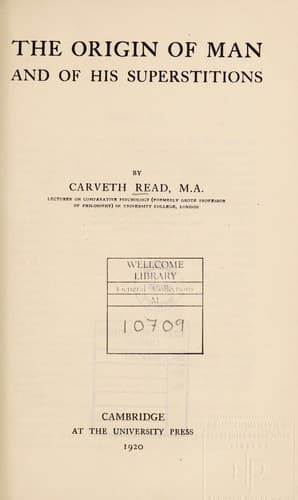
The Origin of Man and of His SuperstitionsRead, Carveth
Philosophy
The Origin of Man and of His Superstitions
Read, Carveth
Animism; Human beings -- Origin; Magic; Superstition; Totemism
(5) Such a temper cannot endure opposition, and is jealous of
rivalry; the man whom it actuates lives in constant fear of failure
and discredit and is, therefore, full of suspicion and cruelty. In
S. Africa, professional hatred is pushed to its last limits amongst
magicians. They test their colleagues, steal each other’s drugs, or
pray to the gods to make their rival’s art inefficient.[458] The savage
sorcerer looks with no kindly eye upon the European; who, too plainly,
possesses extraordinary Magic. Captain Whiffen says[459] of the
sorcerer amongst the South Amerinds, who has much knowledge of poisons,
that to maintain his reputation, if he has declared that he cannot cure
a patient, he poisons him. Of the sorcerer of the Lower Congo, Mr.
Weeks says, that “his face becomes ugly, repulsive, the canvas on which
cruelty, chicanery, hatred and all devilish passions are portrayed with
repellent accuracy.”[460] An extreme case perhaps; but, leading up to
it, there are all degrees of rancour and malignity toward those who
hinder our ambitions; and it can only be in exceptional magicians that
megalomania is reconcilable with considerateness and magnanimity.
(6) Since the greater part of the wizard’s practice is imposture
(whether he believes in himself or not), he must be an actor; and his
success must greatly depend on the degree in which he possesses the
actor’s special gifts and temperament: an audience must be a stimulus
to him and not a check; he exhibits himself not unwillingly. To the
shaman, Miss Czaplicka tells us,[461] an audience is useful: though
the presence of an European is depressing. A Chuckchee shaman without
a sort of chorus considers himself unable to discharge his office:
novices in training usually get a brother or sister to respond to their
exercises. And, indeed, a wizard’s exhibitions often provide without
design the same sort of social entertainment as those of an actor.
One cannot read of the shaman’s performance of a pantomimic journey
on horseback to the South, over frozen mountains, burning deserts,
and along the bridge of a single hair, stretched across a chasm over
foaming whirlpools, to Erlik Khan’s abode, and then home again on the
back of a flying goose, without perceiving that in the wilds of Siberia
such an entertainment, whatever other virtues it may have, supplies the
want of theatres and music-halls, and that in such displays a dramatic
profession might originate.
Public-domain text, read in full here on John Shaqi.
Reviews
Reviews
No reviews yet
Be the first to share your thoughts on this work.
Elsewhere in the archive
Join the Discussion
Join the discussion
Sign in to leave a comment or review.
Sign InorCreate an account