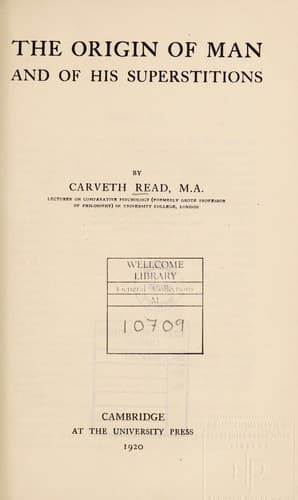
The Origin of Man and of His SuperstitionsRead, Carveth
Philosophy
The Origin of Man and of His Superstitions
Read, Carveth
Animism; Human beings -- Origin; Magic; Superstition; Totemism
A necessary complement to the suggestive devices of a wizard is the
suggestibility of his clients. There is such a thing as an assenting or
a dissenting disposition—suggestibility or contrasuggestibility; but
the latter is, like the former, a tendency to react without reflection,
and may be as well controlled by appropriate suggestions. The power
of any given suggestion to control the course of a man’s thought and
action depends upon the resistance (apart from contra-suggestibility)
which it meets with in his mind; and this depends upon the extent,
quality and integration of his apperceptive masses, and upon the
facility with which they come into action. Upon the perceptual plane a
savage’s mind is well organised, and accordingly his suggestibility is
low; but upon the ideational plane it is in most cases ill organised,
poor in analysis, classification, generalisation, poor in knowledge,
abounding in imagination-beliefs about Magic and Animism; so that,
except in natural sceptics (who, as we shall see, exist among savages),
the suggestions of the wizard meet with little resistance from common
sense and with ready acceptance by magical and animistic prejudice.
But even with a man of common sense, a suggestion, however absurd,
may for a time prevail, if his mental reaction is slow; although,
with time for reflection, he will certainly reject it. The art of the
wizard consists in getting such hold of his client’s attention that,
as in hypnosis, the power of reflective comparison is suspended and
criticism abolished. There are many masters of this art. The client’s
state of mind is very common in the effects of oratory, the theatre,
ghost-stories and generally in the propagation of opinion, suspicion
and prejudice.
§ 4. THE WIZARD AND THE SCEPTIC
Inasmuch as the wizard’s boasting, conjuring, ventriloquising,
dramatising and practising of all the arts of suggestion, seem
incompatible with sincerity, whilst nevertheless he is devoted to his
calling, some observers have declared him a calculating impostor,
whilst others maintain that he, in various degrees, believes in himself
and shares the delusions which he propagates. Examples may be found in
support of either position.
Public-domain text, read in full here on John Shaqi.
Reviews
Reviews
No reviews yet
Be the first to share your thoughts on this work.
Elsewhere in the archive
Join the Discussion
Join the discussion
Sign in to leave a comment or review.
Sign InorCreate an account