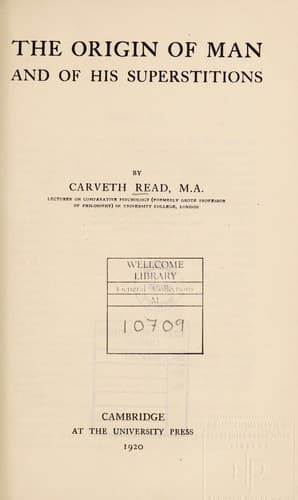
The Origin of Man and of His SuperstitionsRead, Carveth
Philosophy
The Origin of Man and of His Superstitions
Read, Carveth
Animism; Human beings -- Origin; Magic; Superstition; Totemism
(7) Wizards are very often people who manifest an hysterical or
epileptoid diathesis; and candidates for the profession who show signs
of it are often preferred by the doctors. According to Miss Czaplicka,
hysteria (common in Siberia) is at the bottom of the shaman’s vocation:
but it is not merely a matter of climate; for the Rev. E. T. Bryant
writes of the Zulus—“the great majority of diviners being clearly of
neurotic type”;[463] and on all sides we obtain from descriptions of
wizards the same impression. The word “shaman” comes not, as usually
supposed, from the Sanskrit (_śramana_ = work, a religious mendicant),
but from _saman_, which is Manchu for “one who is excited, moved,
raised.”[464] The effect on the audience of shamanising depends in
great measure upon the fits, ecstasy, convulsions introduced at some
stage of the performance and attributed to possession by the spirits.
Similar exhibitions have been reported by all observers of wizardry.
Professor Otto Stoll of Zurich has described[465] the phenomena as they
occur in all countries and all ages; and he attributes them, as well as
hallucinations and analgesia (as in the fire-walk), which wizards also
have at command, to the power of self-suggestion acquired by practice
and training, on the basis (of course) of a natural disposition.
Cagliostro declared that he could smell atheists and blasphemers; “the
vapour from such throws him into epileptic fits; into which sacred
disorder he, like a true juggler, has the art of falling when he
likes.”[466] The wizard’s fits are voluntarily induced; but from the
moment the attack takes place the development of its symptoms becomes
automatic. Between the fits, however, says Miss Czaplicka, he must be
able to master himself, or else he becomes incapable of his profession:
nervous and excitable often to the verge of insanity, if he passes that
verge he must retire.[467] In short, his ecstasy is the climacterical
scene of his dramatic performance, the whole of which must be rendered
with the disciplined accuracy of an artist. We are not to think of the
shaman as an hysterical patient: if he were, there would be greater,
not less, reason to suspect him of deceit. No doubt the training which
gives control of the nervous attack protects the subject from its
unwholesome consequences; there seems to be no special liability to
disease or to a shortening of life. Formerly in Siberia, before the
power of the profession was broken by immigrant beliefs and practices,
it was necessary that the shaman should be well-developed mentally
and physically (as has often been required of priests); and such a
constitution is by no means incompatible with an intense histrionic
temperament.
Public-domain text, read in full here on John Shaqi.
Reviews
Reviews
No reviews yet
Be the first to share your thoughts on this work.
Elsewhere in the archive
Join the Discussion
Join the discussion
Sign in to leave a comment or review.
Sign InorCreate an account