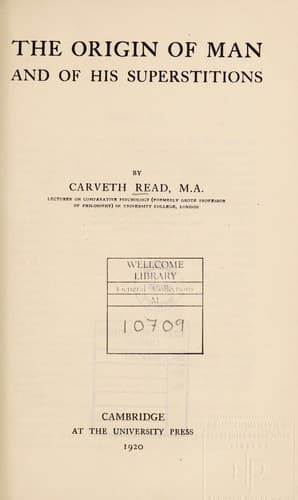
The Origin of Man and of His SuperstitionsRead, Carveth
Philosophy
The Origin of Man and of His Superstitions
Read, Carveth
Animism; Human beings -- Origin; Magic; Superstition; Totemism
Sometimes the dictates of common sense are imposed by necessity. The
Motu (Papuasian) were accustomed to rub spears with ginger to make
them fly straight. It had, however, been discovered that no amount
of Magic would turn a poor spearman into an accurate thrower.[493]
Spear-throwing is too serious a concern not to be judged of upon its
merits, however interesting the properties of ginger. A whole tribe may
in some vital matter, whilst practising a superstitious rite, disregard
its significance: like the Kalims, who hold a crop-festival in January,
and afterwards take the omens as to what ground shall be cultivated for
next harvest; “but this seems a relic of old times, for the circle of
cultivation is never broken, let the omens be what they may.”[494] That
is a tacit triumph of common sense.
The bearing of all this on the character of the wizard is as follows:
since everywhere sceptics occur, and some individuals go further than
others in openly or secretly rejecting superstitions, why should not
the wizard or sorcerer, who is amongst the most intelligent and daring
of his tribe, be himself a rationalist and, therefore, a conscious
impostor? That much of his art is imposture no one disputes; and so far
as it is so, he sees it as part of the ordinary course of experience.
The sorcerer on the Congo who drove a spirit into the dark corner of
a hut, stabbed it there, and showed the blood upon his spear, having
produced the blood (as his son confessed to Mr. Weeks) by scratching
his own gums, was by that action himself instructed in common
sense.[495] He saw in it quite plainly an ordinary course of events,
the “routine of experience”; whilst the spectators were mystified. Must
he not, then, have more common sense than other people?
Public-domain text, read in full here on John Shaqi.
Reviews
Reviews
No reviews yet
Be the first to share your thoughts on this work.
Elsewhere in the archive
Join the Discussion
Join the discussion
Sign in to leave a comment or review.
Sign InorCreate an account