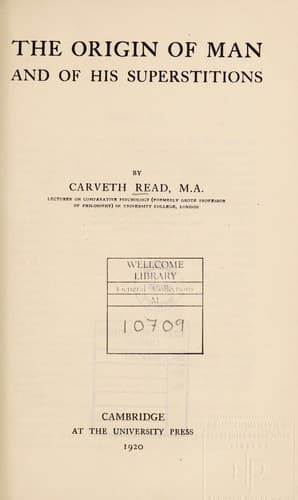
The Origin of Man and of His SuperstitionsRead, Carveth
Philosophy
The Origin of Man and of His Superstitions
Read, Carveth
Animism; Human beings -- Origin; Magic; Superstition; Totemism
in some neurotics becomes a passion capable of supporting them at the
stake. Hence the malevolent wizard may feel a vocation, may believe in
his own powers; and, of course, he will be confirmed in his belief by
the fear excited wherever his reputation spreads. If you put yourself
in his place whilst practising some unholy rite, you may become aware
that the secrecy, the cunning, the danger, the villainy and the
elation of it exert a peculiar fascination, and that this is enhanced
by foul and horrible usages, such as appeal to the perverted appetites
of insanity.
(_b_) The deceit employed by a wizard in conjuring, ventriloquising,
dressing up, keeping a “familiar,” choosing favourable opportunities
for his _séance_ and inciting himself to frenzy, seems incompatible
with sincerity; but whilst he knows such proceedings to be artifices,
he also knows them to be necessary to the effect which he produces.
For that effect, so far as it depends upon wizardly practices, not on
such means as massage, or poisons, or drugs, is always subjective—an
influence on other men’s belief. Are we not demanding of him greater
discrimination than he is likely to enjoy, if we expect him to see
the hollowness of his profession, because some of the means by which
he operates are not what his clients suppose them to be? If it be
said that the wizard’s stock excuses for failure—that there has been
a mistake in the rites, or that another wizard has counteracted his
efforts—are those of a man who has anticipated detection in fraud and
prepared a way of escape, it may be replied that, according to accepted
tenets concerning wizardry, these excuses are reasonable and not
necessarily subterfuges.
The professional attitude may induce a man to exonerate himself and
his colleagues in certain dubious dealings, for the sake of the public
utility of their office on the whole; which is so manifest to him and
to them, and is also acknowledged by the public. For a wizard’s belief
in his art is supported by the testimony of other wizards, in whom he
also believes, and by the belief of the tribe generally in the power of
the profession, even though he himself be not greatly esteemed. “Who am
I,” he will ask, “that I should have a conscience of my own?” And if
this attitude is inconsistent with keen intelligence and megalomania,
such inconsistency is not inconsistent with our experience of human
nature.
(_c_) The effects produced by charms, spells and rites, simple or to
the last degree elaborate, purely magical or reinforced by spirits, are
always subjective, but are believed to have a much wider range. The
wizard seems to make the sun rise when he summons it just in time every
morning; to cause clouds to gather in the sky when he invokes them just
before the rainy season; and so on. Such performances convince others,
but seem to us poor evidence for any one who is in the secret. He is
not, however, left without further evidence of three kinds:
Public-domain text, read in full here on John Shaqi.
Reviews
Reviews
No reviews yet
Be the first to share your thoughts on this work.
Elsewhere in the archive
Join the Discussion
Join the discussion
Sign in to leave a comment or review.
Sign InorCreate an account