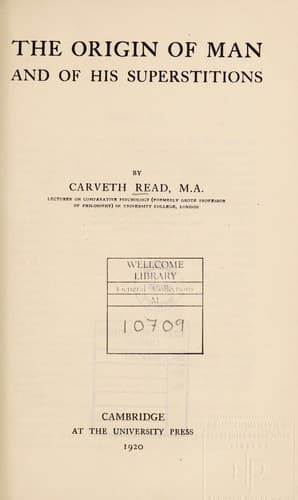
The Origin of Man and of His SuperstitionsRead, Carveth
Philosophy
The Origin of Man and of His Superstitions
Read, Carveth
Animism; Human beings -- Origin; Magic; Superstition; Totemism
By practice he acquires—as for their
own tasks all artists, poets and actors must—a facility in inducing
the state of dissociation (more or less strict), in which work goes
smoothly forward under the exclusive dominance of a certain group
of ideas and sentiments. Whether, in this condition, he believes in
himself and his calling, or not, is a meaningless question. Whilst the
orgasm lasts there is no place for comparison or doubt. And since he
really produces by his frenzy or possession a great effect upon the
spectators—though not always the precise effect of curing a patient or
of controlling the weather at which he aimed—we need not wonder if he
believes himself capable of much more than he ever accomplishes. The
temperament, most favourable to a wizard’s success is not likely to be
accompanied by a disposition to the positive or sceptical attitude of
mind. Moreover, to the enthusiast for whom belief is necessary, it is
also necessary to create the evidence. That the end justifies the means
is not his explicit maxim, but a matter of course. Gibbon comments on
“the vicissitudes of pious fraud and hypocrisy, which may be observed,
or at least suspected, in the characters of the most conscientious
fanatics.”[504] After failures, indeed, or in the languor that follows
his transports, there may come many chilling reflections; only,
however, to be dispersed by an invincible desire to believe in his own
powers and in the profession to which he is committed.
The “white” wizard may pacify a troubled conscience by reflecting
that at any rate he discharges a useful social function; as, in fact,
he does, so far as he relieves the fears of his tribesmen and gives
them confidence. To understand the “black” wizard, we must turn to
the dark side of human nature. That a man should resort to magic or
sorcery to avenge himself or his kinsmen, or to gratify his carnality,
jealousy or ambition, is intelligible to everybody; but that he should
make a profession of assisting others for a fee to betray, injure, or
destroy those with whom he has no quarrel, seems almost too unnatural
to be credible. Yet it admits of a very easy explanation. The love
of injuring and slaying is deeply rooted in us: men afflicted with
homicidal neurosis are known to the asylums and to the criminal courts
of all civilised nations; assassins on hire have often been notoriously
obtainable. To slay in cold blood by violence, or even by poison,
seems, however, less revolting than to slay by sorcery and obscene
rites. But the fascination of this employment may be further understood
by considering the attraction that secret power and the proof of their
own cunning has for many people. To slay is sweet; but the ancient
hunter depended more upon strategy than upon the frontal attack; and no
strategy is so secret or needs so much skill as the Black Art. Finally,
if sorcery is persecuted, it excites the contra-suggestibility which
Public-domain text, read in full here on John Shaqi.
Reviews
Reviews
No reviews yet
Be the first to share your thoughts on this work.
Elsewhere in the archive
Join the Discussion
Join the discussion
Sign in to leave a comment or review.
Sign InorCreate an account